


2026 Propel survey of EBT theft awareness and impact
Our editorial promise
All of our Propel editorial content meets our high bar for accuracy, timeliness, trust, and relevance. Our pages are edited and fact-checked to make sure we meet our mission of giving you information you can rely on.
Learn more about our editorial standards.
- Background
- Executive Summary
- The scope of EBT theft
- Awareness of EBT theft
- Recent patterns of EBT theft
- The impact of EBT theft
- Security feature adoption
- Advancing systemic protections
- Chip cards in California reduce theft, implementation processes are key to success
- Promoting security feature adoption via Propel
- Conclusion
- Methodology
- About Propel
Table of contents
- Background
- Executive Summary
- The scope of EBT theft
- Awareness of EBT theft
- Recent patterns of EBT theft
- The impact of EBT theft
- Security feature adoption
- Advancing systemic protections
- Chip cards in California reduce theft, implementation processes are key to success
- Promoting security feature adoption via Propel
- Conclusion
- Methodology
- About Propel
Background#background
Electronic Benefits Transfer (EBT) cards are the primary delivery mechanism for public benefits, including SNAP and TANF, helping millions of low-income families across the U.S. put food on the table each month. EBT theft is the illegal theft of public benefits from the accounts of eligible low-income beneficiary households through electronic means. EBT theft often happens through "card skimming" when information is stolen directly off of EBT cards swiped at compromised point-of-sale devices or ATMs, or phishing schemes that target people who get government benefits.
These terrible crimes are often perpetrated by organized gangs of foreign criminals. EBT theft harms vulnerable families, undermines the important work of state agencies, and robs the American taxpayer. Ending EBT theft requires a collaborative effort. States and their vendors continue to add new security options for their client households, including the introduction of the first EBT chip cards in California in 2025. Propel continues to help customers protect their benefits by promoting security feature adoption, adding proprietary tools, promoting consumer awareness, and by supporting law enforcement and program integrity efforts with aggregated data, and delivering insights to support policymakers in designing effective, systematic solutions.
Propel's 2025 Survey of EBT Theft Awareness and Impact ran from February 1-10, 2026 and collected responses from 8,164 EBT cardholders nationwide, including 1,451 recent victims of EBT theft. This large scale survey is unique in its reach among SNAP recipients and impacted individuals.¹
Executive Summary#executive-summary
Since exploding into prominence in 2022, EBT theft has continued to plague already vulnerable low-income households. Propel estimates that more than $600 million was stolen from the accounts of EBT households in 2025. Against this background, households at risk of and impacted directly by EBT theft shared with us the following:
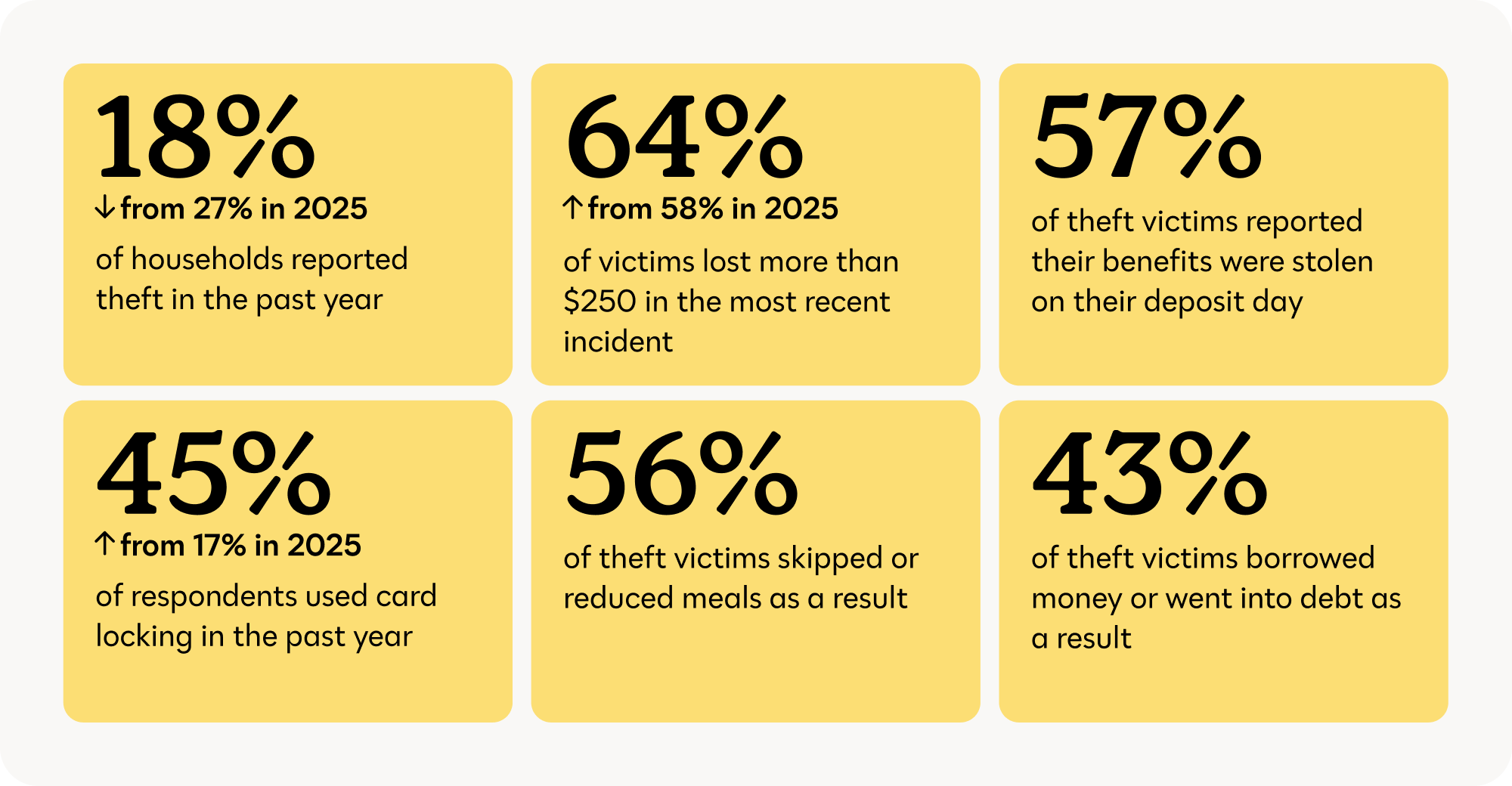
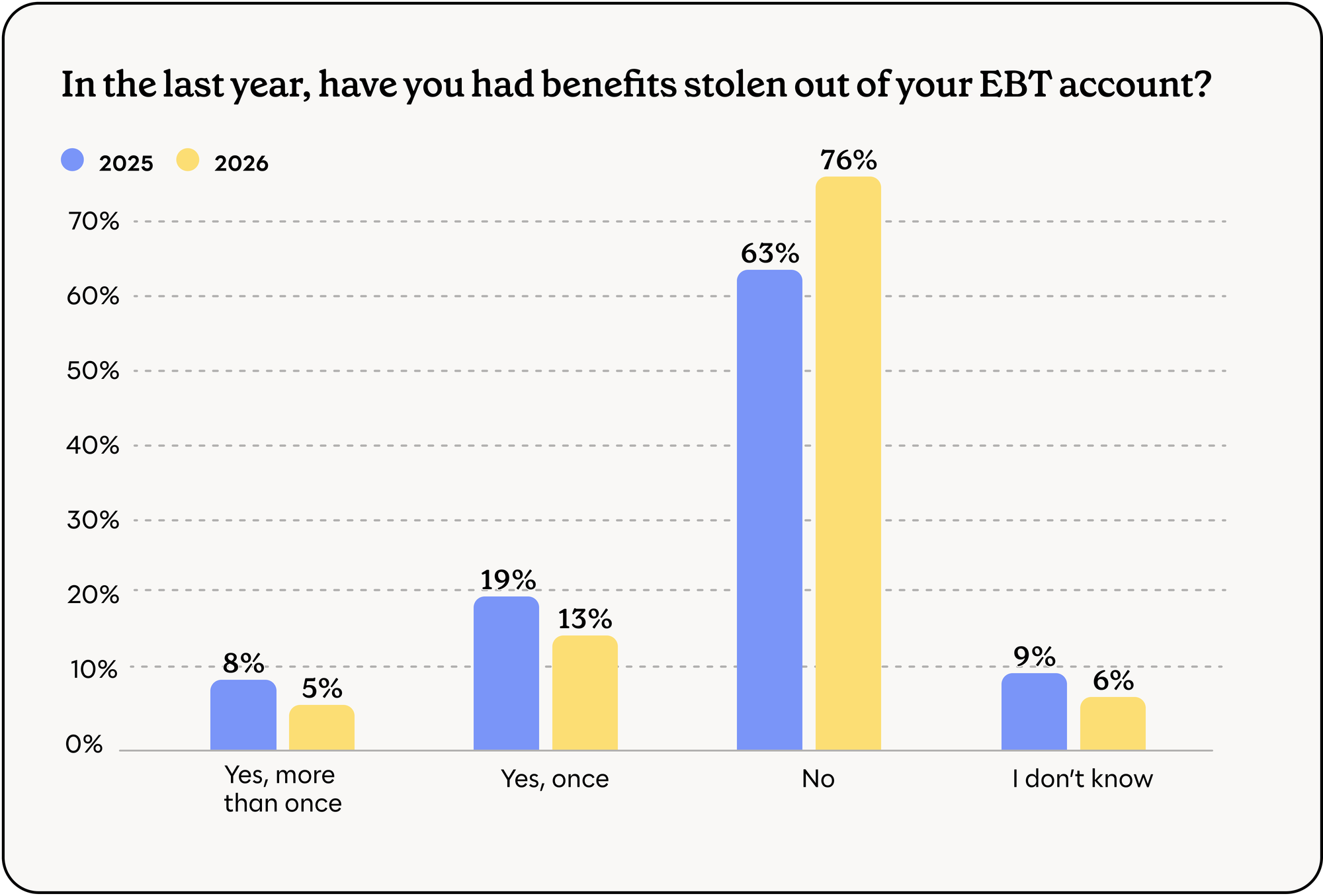
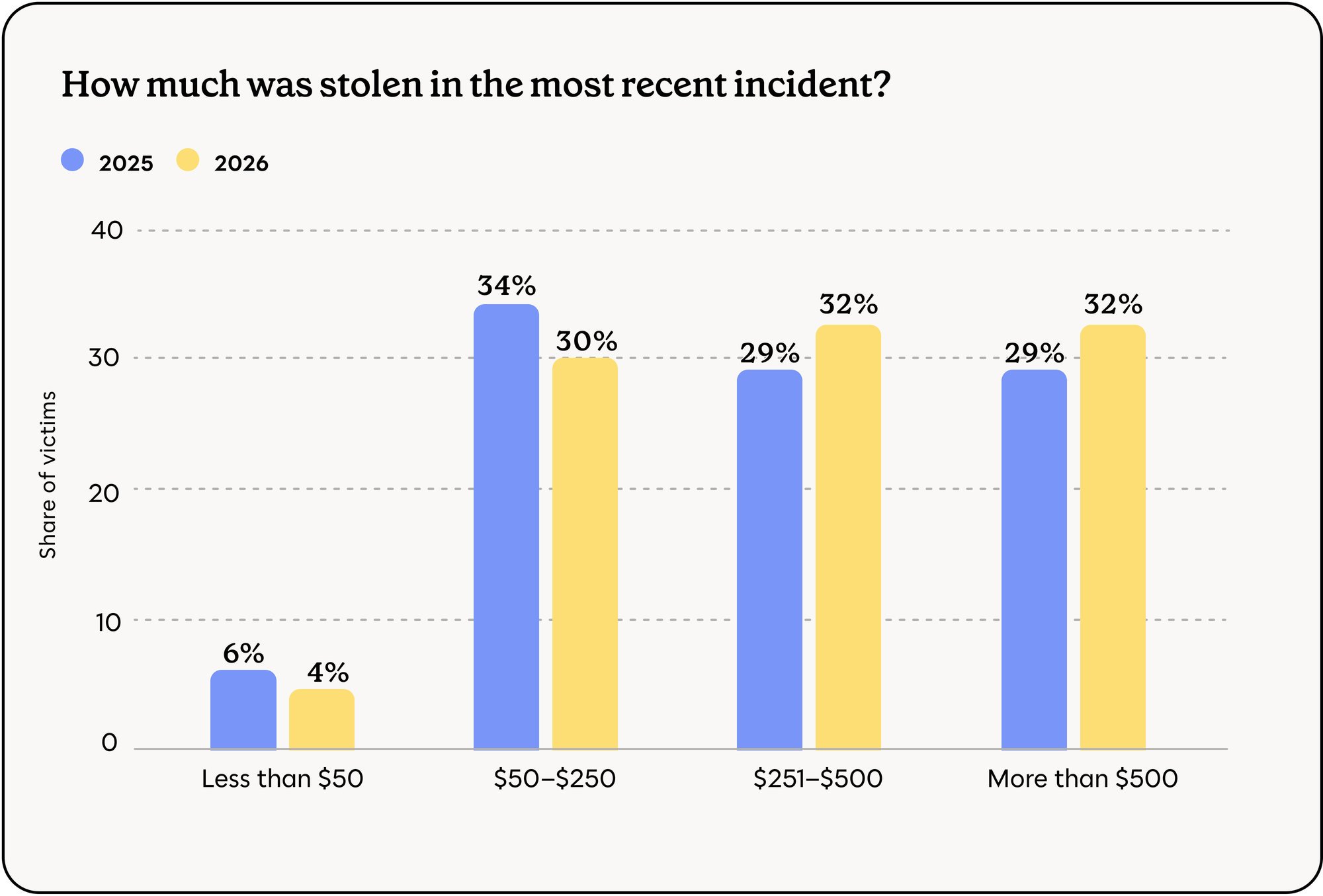
- The share of households reporting theft in the past year declined, but losses remain severe. 18% report benefits stolen (down from 27% in 2025), yet among victims, larger losses are more common: 64% lost more than $250, and 32% lost over $500.
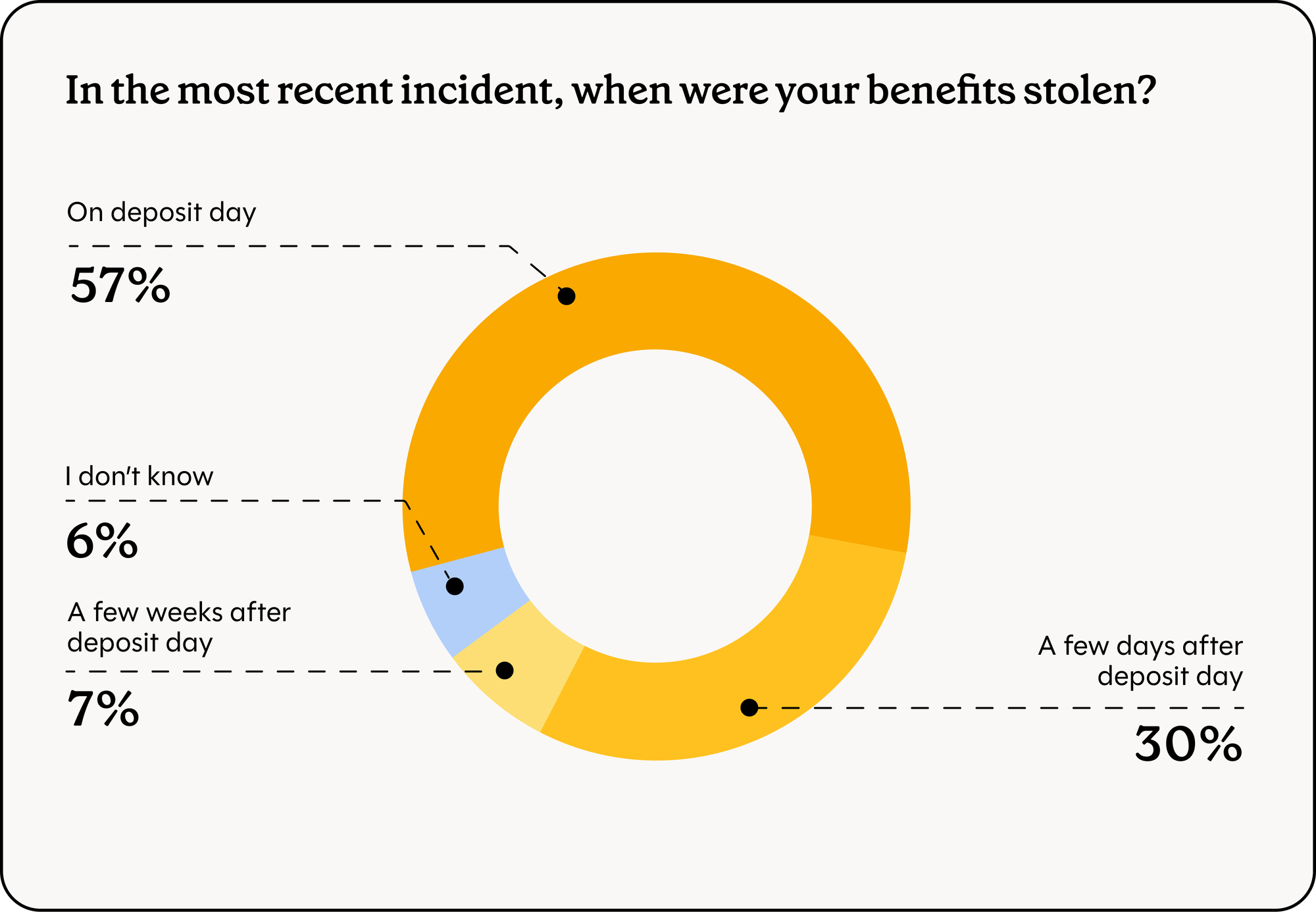
- EBT theft continues to happen on deposit day. 57% of victims say their most recent theft occurred on deposit day, reinforcing that criminals time theft to maximize harm.
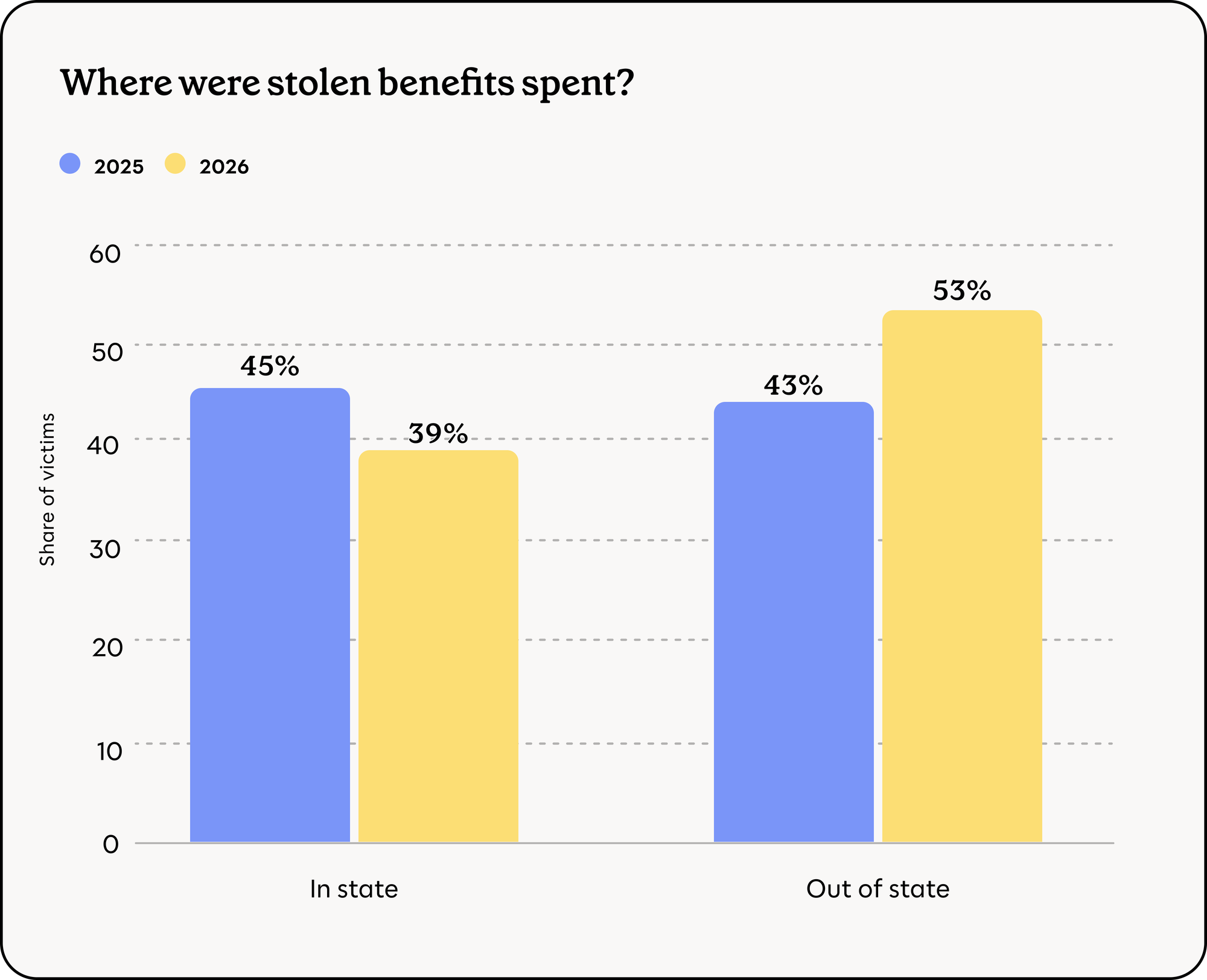
- Theft occurs both in-state and out-of-state. 53% of victims report their stolen benefits were spent outside their home state (up from 43% in 2025), underscoring that theft networks are dynamic and unbounded by geography.
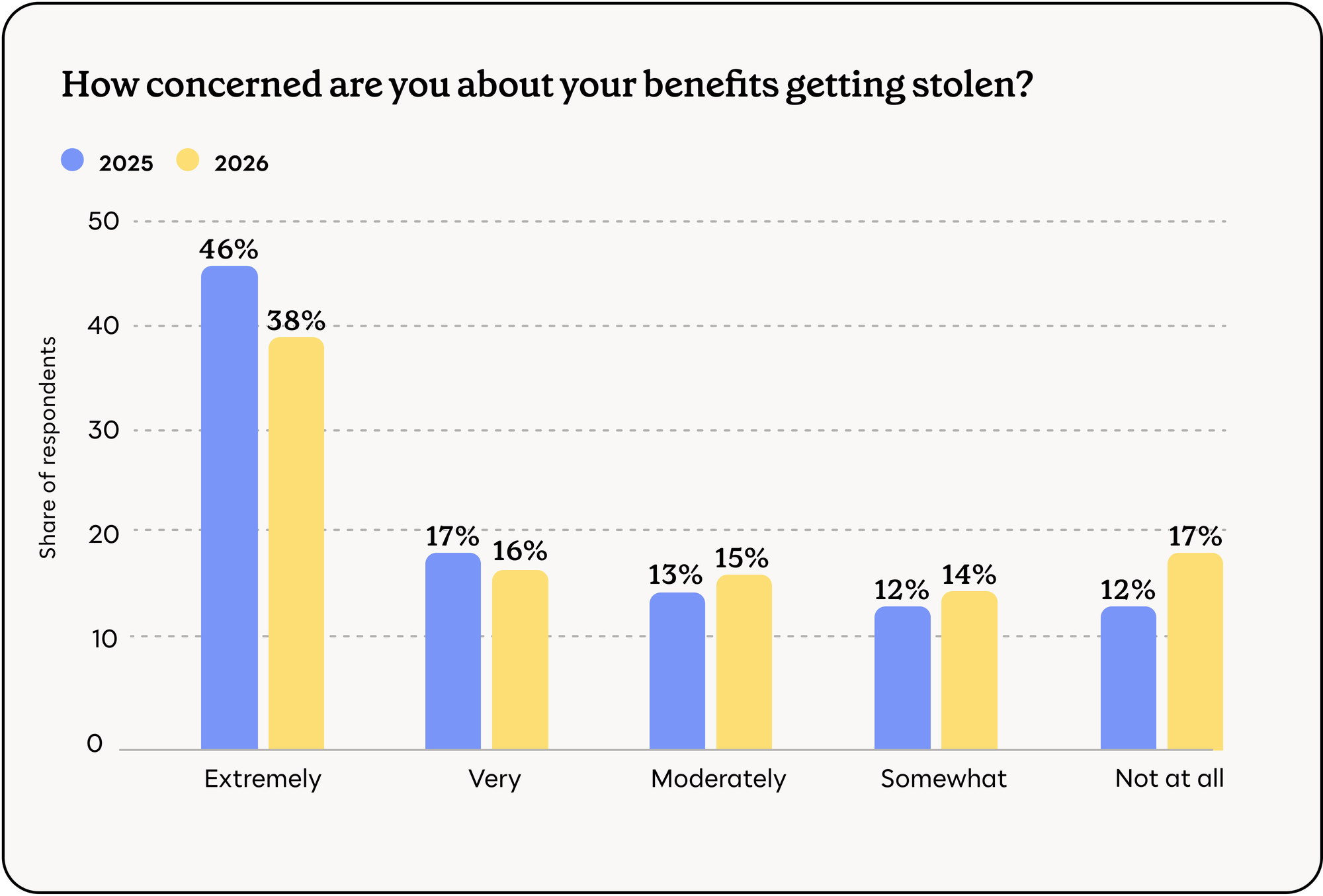
- Concern about theft has softened slightly, but remains widespread. The share of respondents who are "extremely" concerned fell from 46% to 38%, and those "not at all concerned" rose from 12% to 17%. Awareness continues to climb: 36% now regularly hear about theft, and only 13% say they have never heard about it.
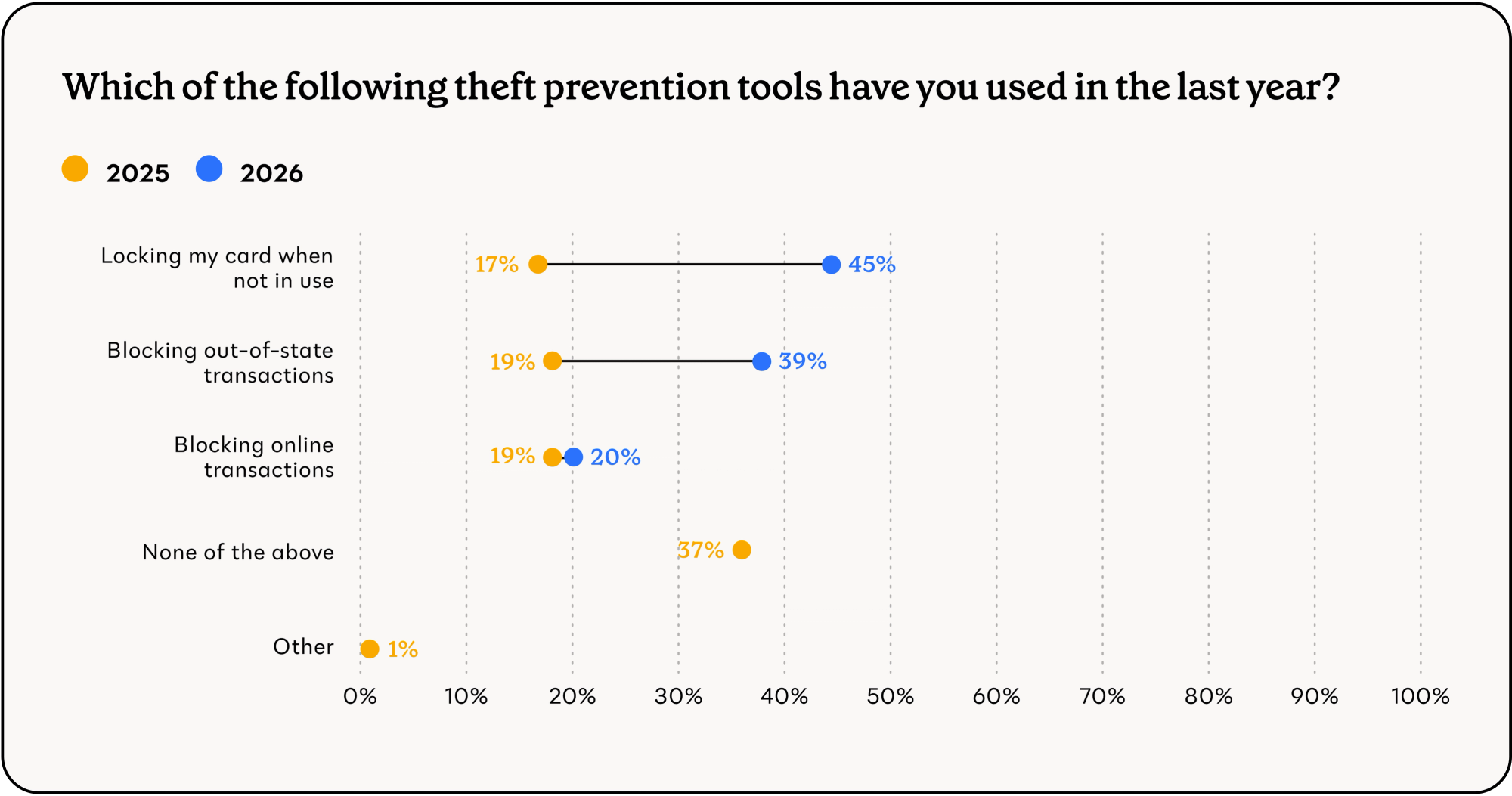
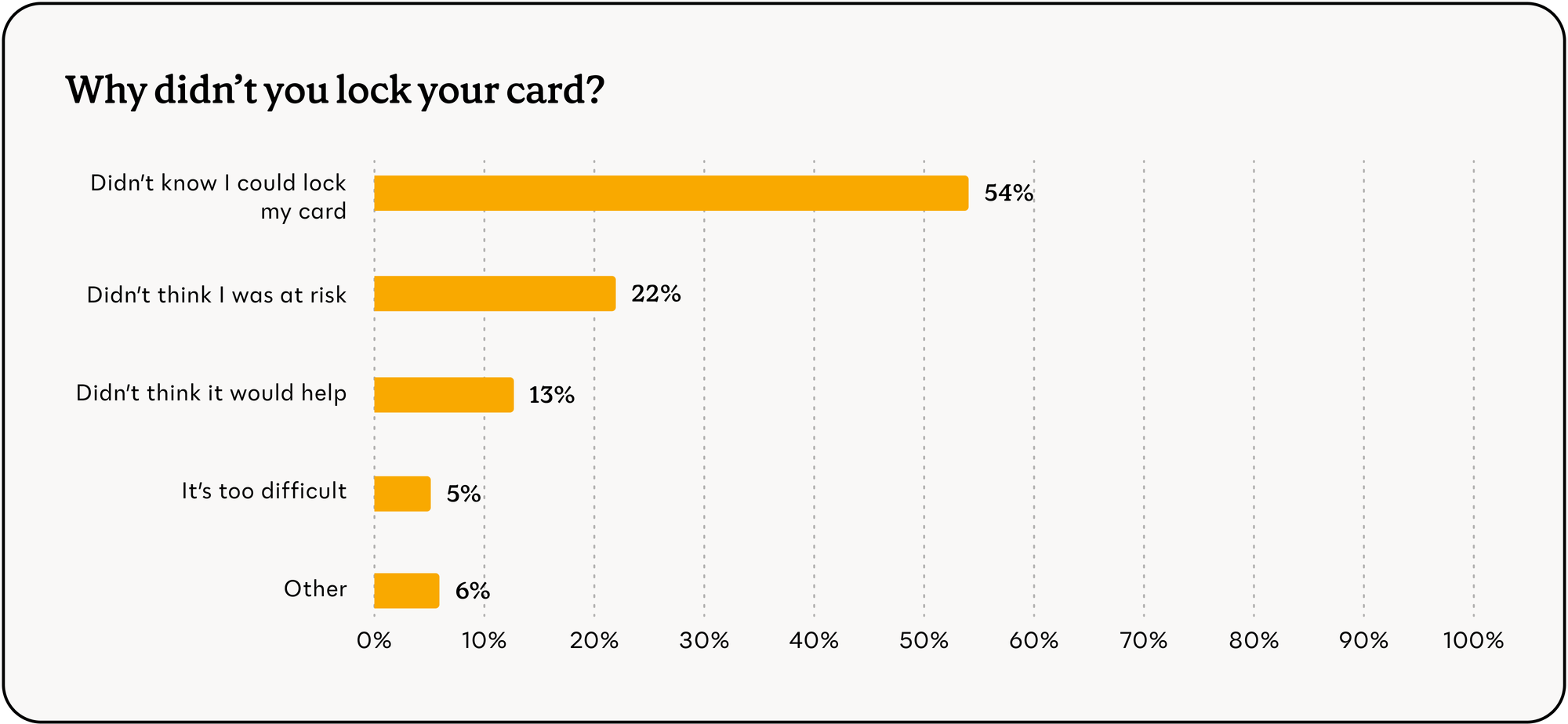
- Card locking and security feature usage has surged among Propel users, but awareness gaps persist. Use of card locking among Propel users jumped from 17% to 45%, and use of out-of-state transaction blocking rose to 39%. Among those who do not lock their card, 54% say they didn't know they could, highlighting ongoing communication and access gaps.
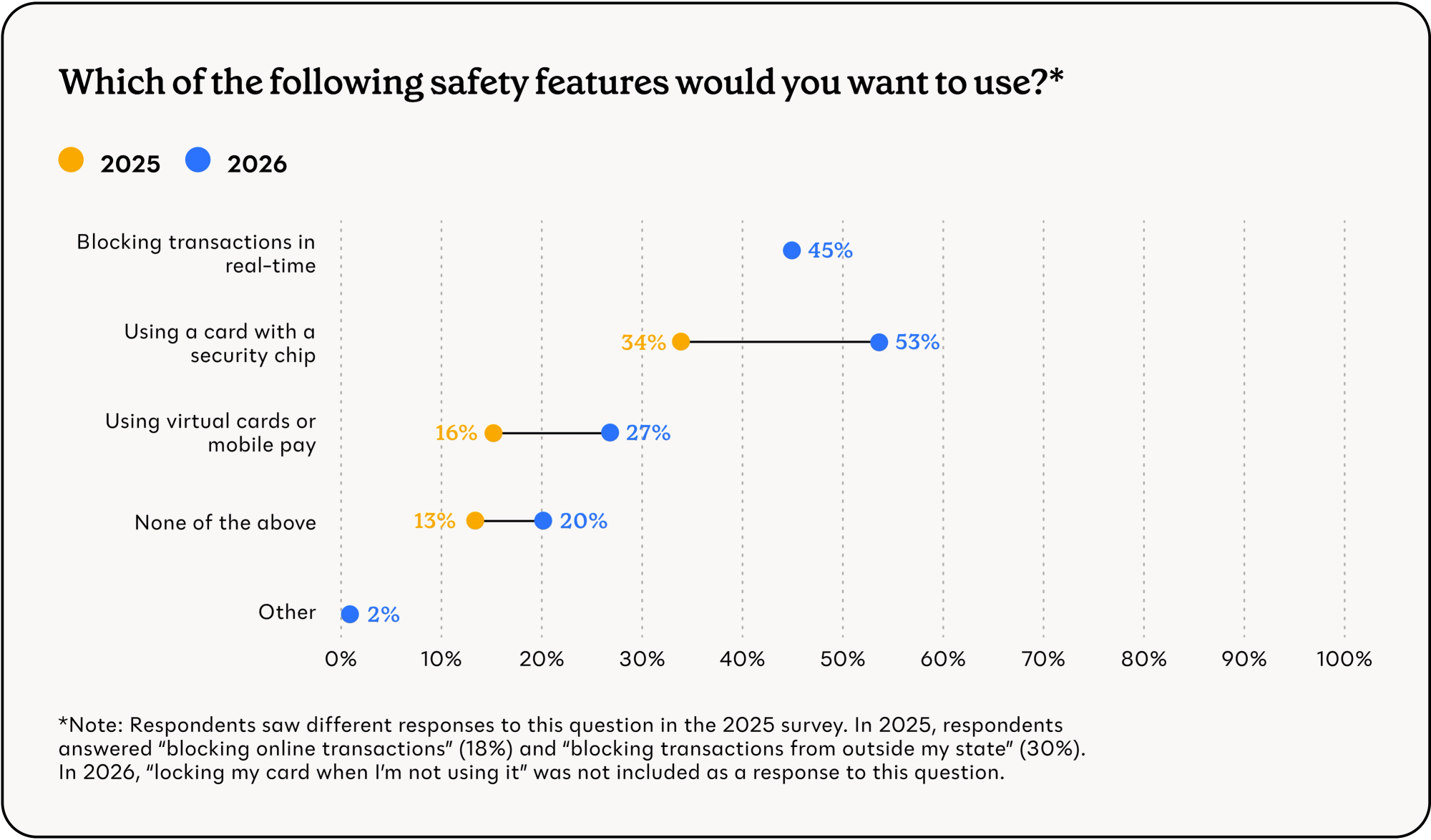
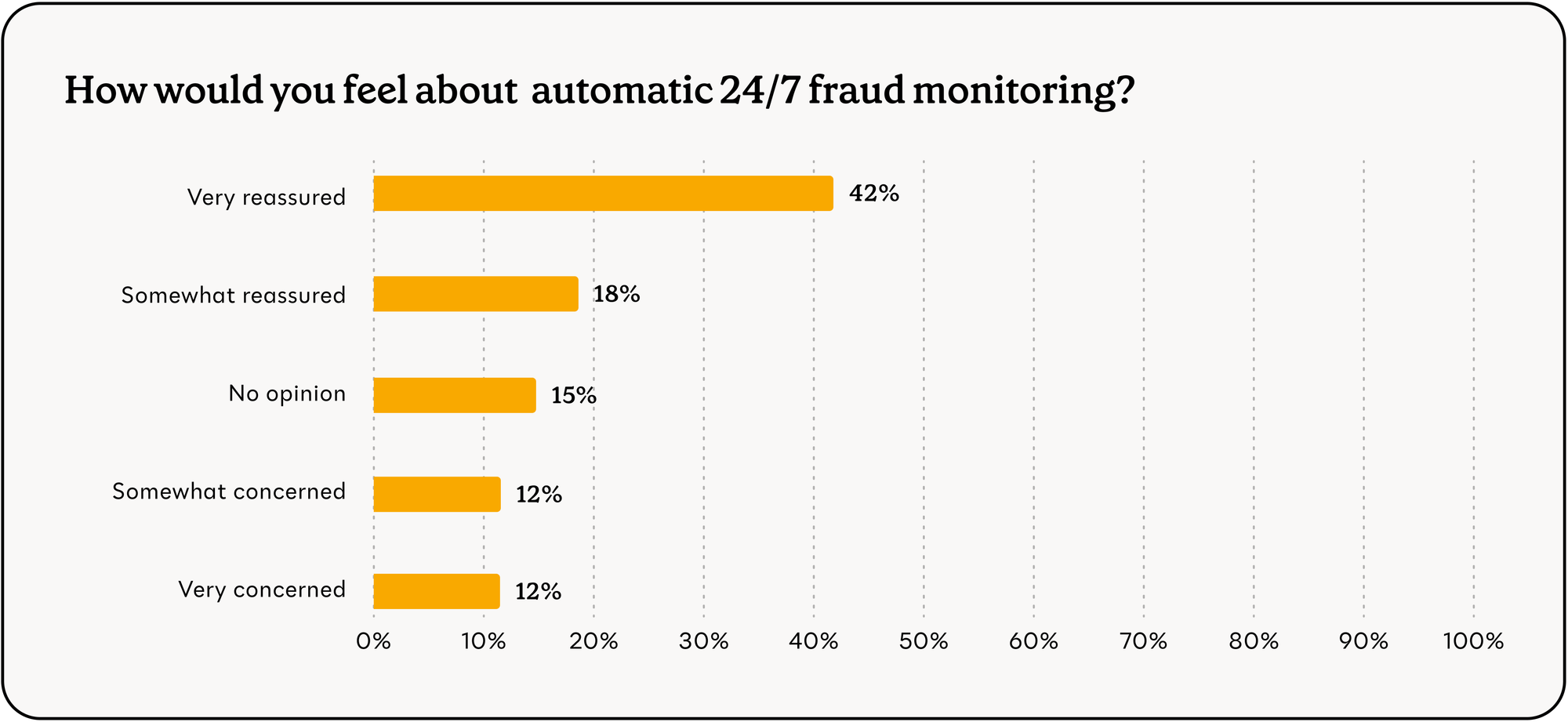
- Households strongly favor systemic protections. 53% say they want to use a chip card (up from 34%), and 60% say they would feel reassured by automatic 24/7 fraud monitoring that blocks suspicious transactions.
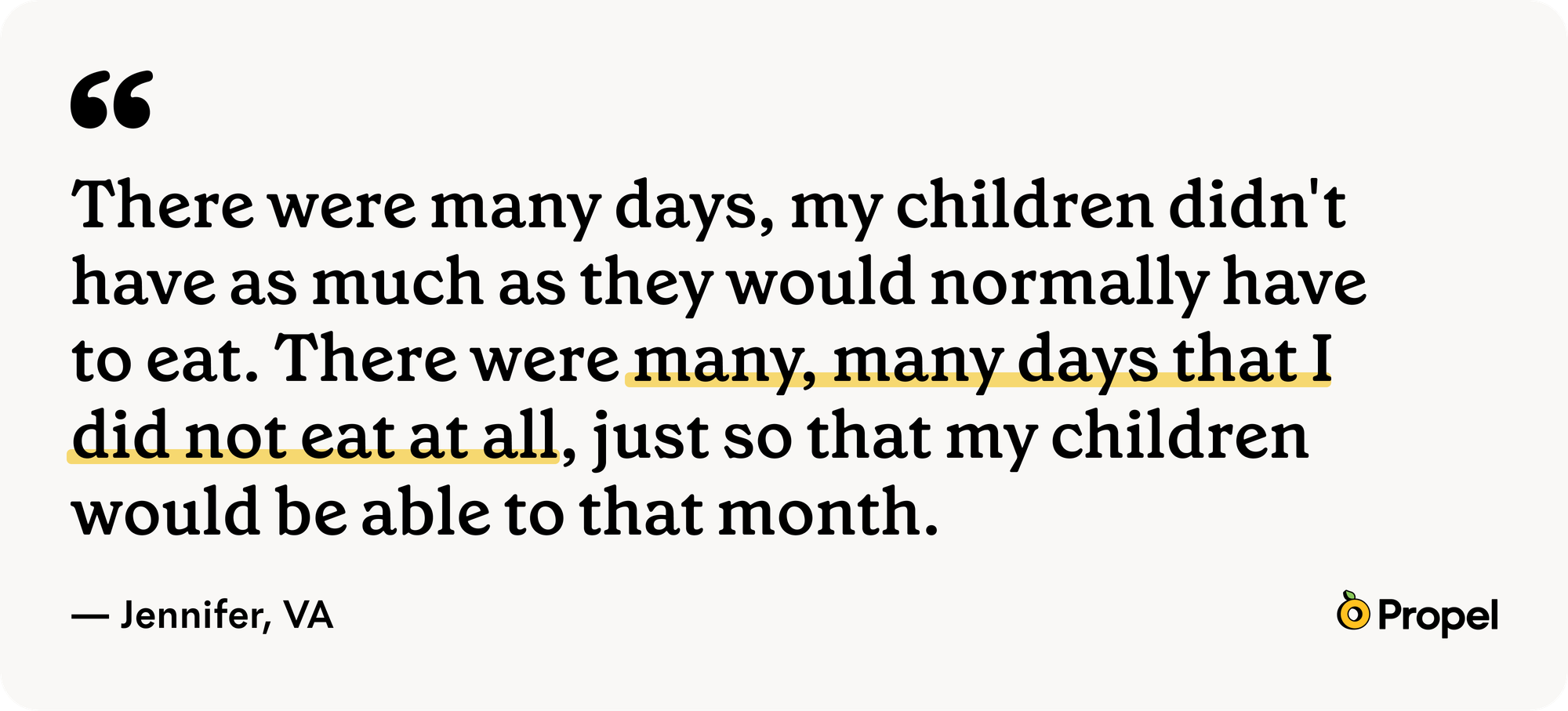
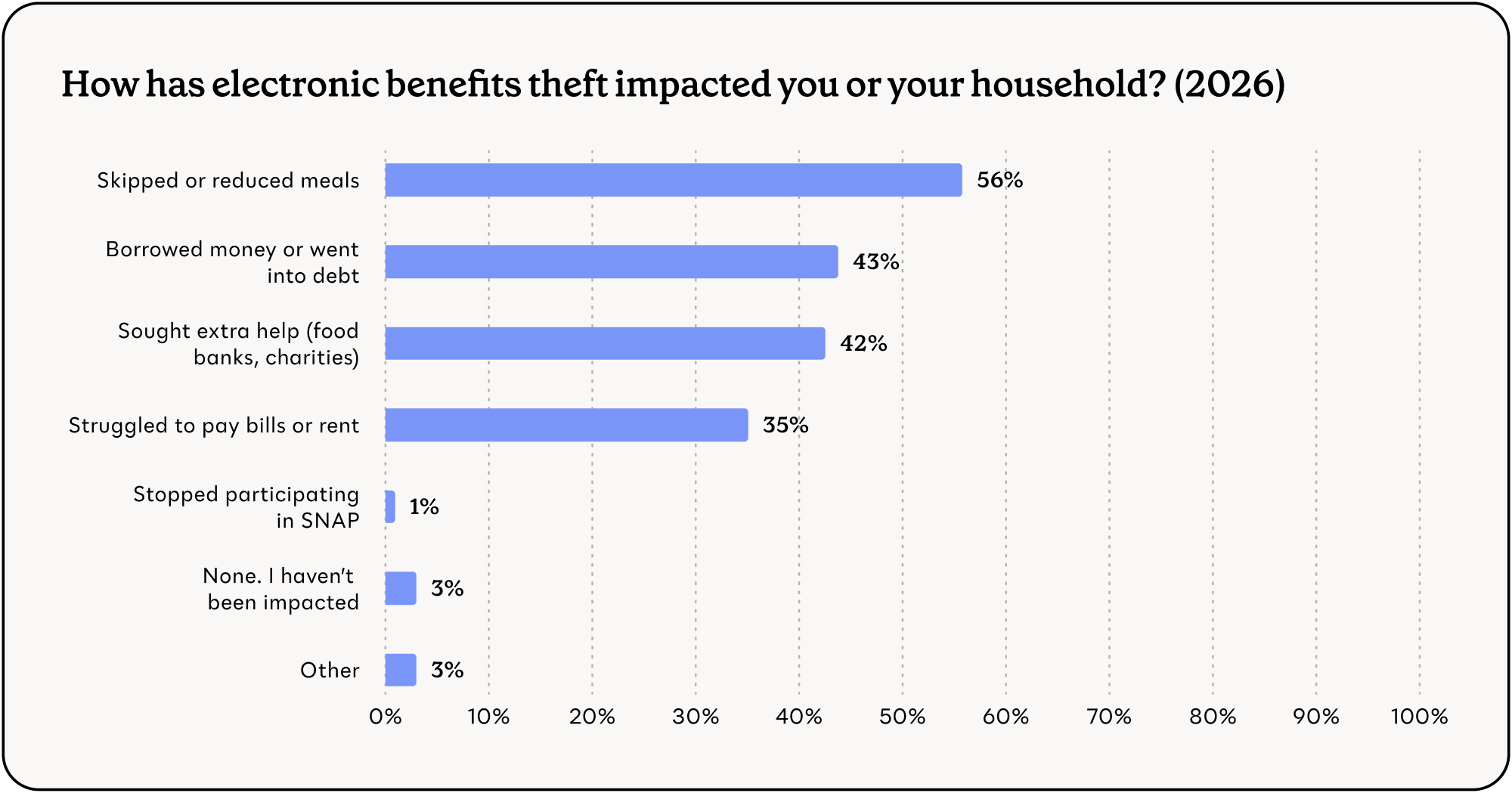
- The human toll remains profound. Among 2026 theft victims, 56% skipped or reduced meals, 43% borrowed money or went into debt, 42% sought help from food banks or charities, and 35% struggled to pay bills or rent.
The scope of EBT theft#the-scope-of-ebt-theft
Propel estimates that approximately $607 million was stolen from households that receive public benefits via EBT in calendar year 2025.
People who use Propel have the option to report unrecognized transactions via the app and do so at scale. Propel uses these reports to identify retailers where unrecognized transactions occur at an unusually high rate.
We reach this estimate by assuming that all transactions at these retailers are fraudulent during the duration of the elevated reporting rate, then adjusting to account for 20+ states that do not provide their EBT households with retailer name data, and the portion of SNAP households served by Propel (roughly 1 in 4). ²
Awareness of EBT theft#awareness-of-ebt-theft
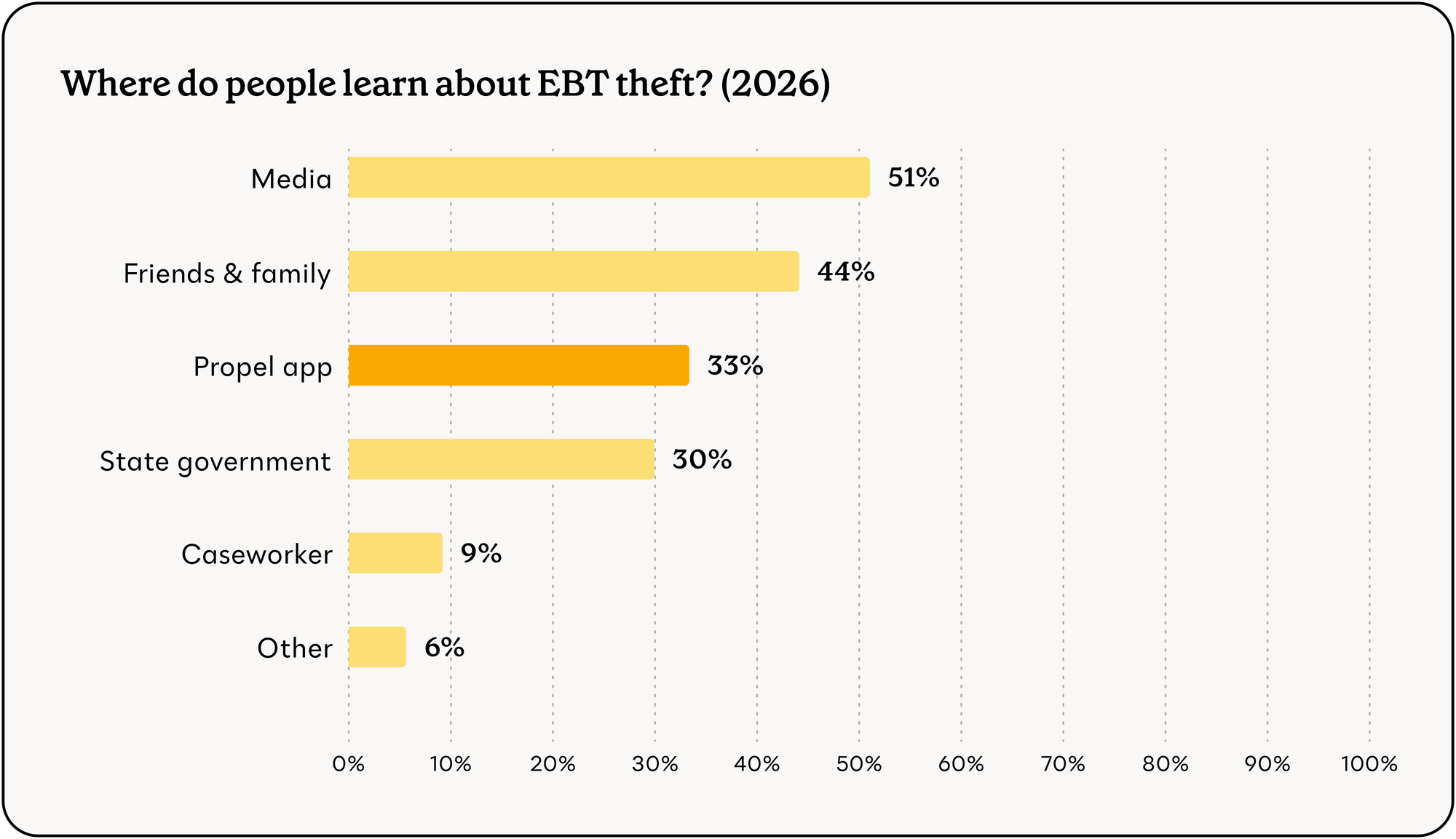
Awareness of EBT theft is at an all-time high among Propel users. However, who's delivering that information may reveal a gap in official outreach, as the media, friends and family, and the Propel app all appear as more common sources of information than official state government sources or caseworkers.
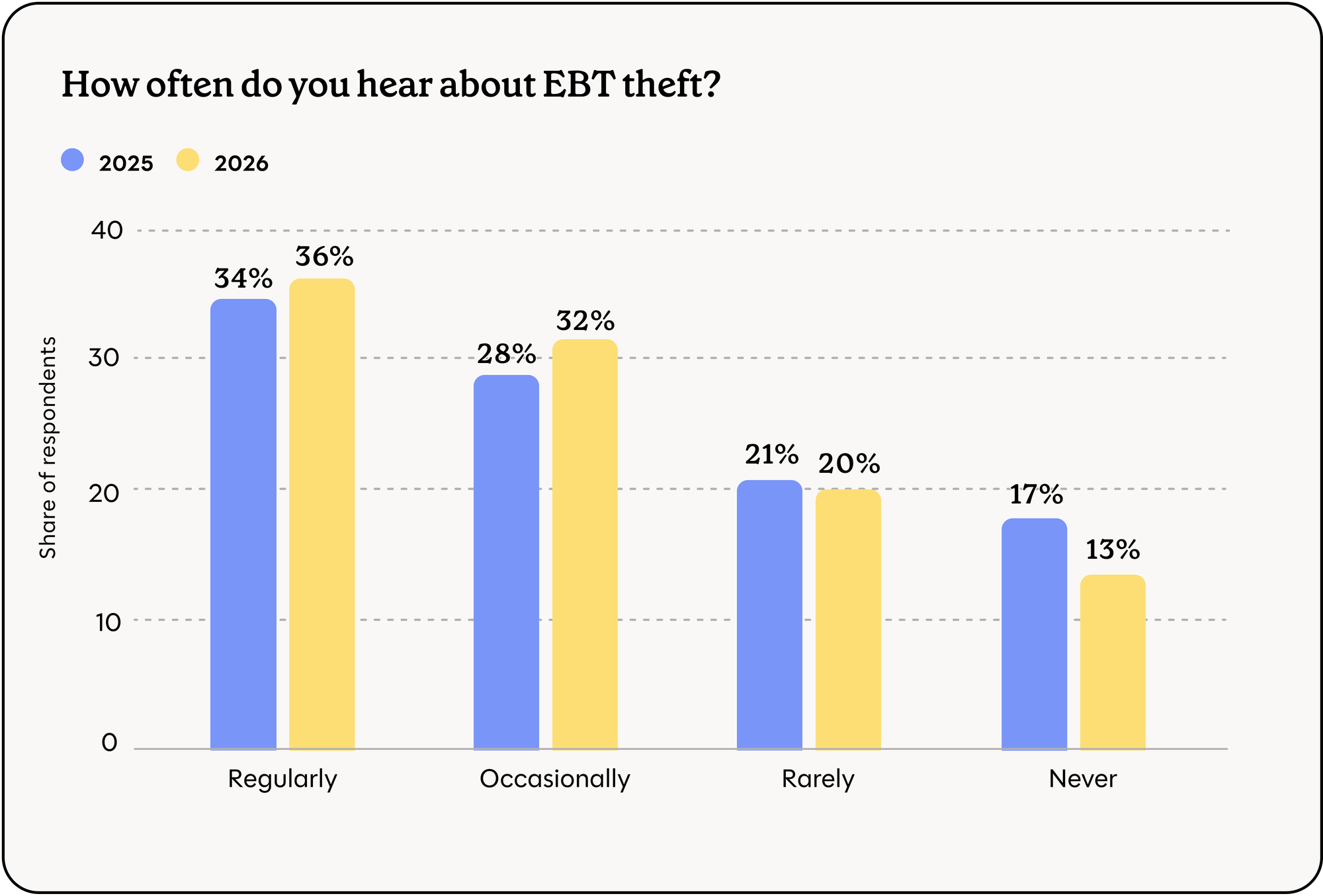
Respondents' degree of concern about EBT theft has ebbed from a year ago, perhaps reflecting increased availability and adoption of security tools, a normalization of the experience of EBT theft, or some other factor.
Recent patterns of EBT theft#recent-patterns-of-ebt-theft
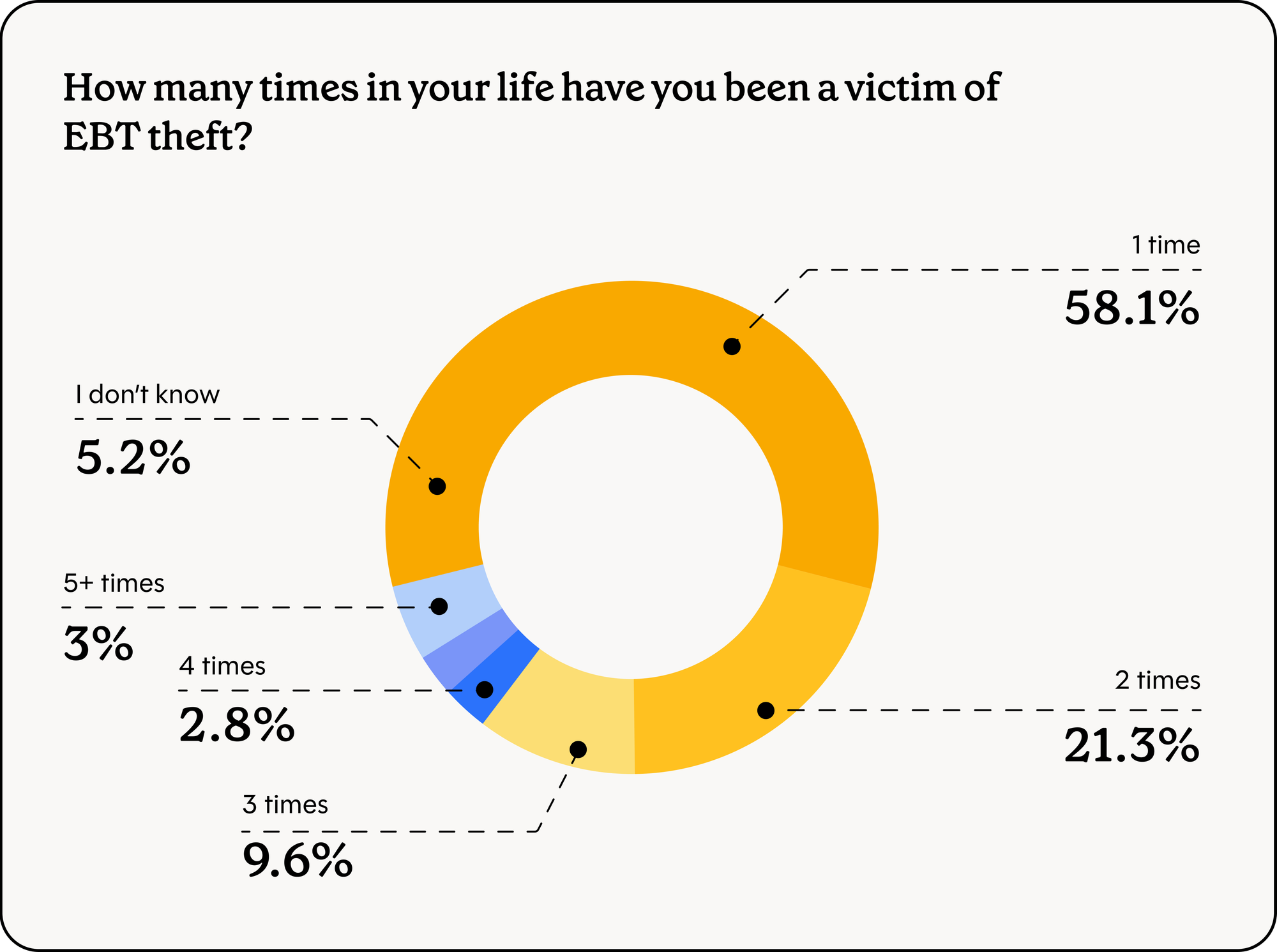
Fewer households reported recent theft than in 2025, but remains disturbingly high, as 18% of respondents reported at least one incidence of theft. Repeat victimization is also reduced, but distressingly common, with 5% of respondents reporting multiple thefts in 2025. Victims on average are losing more in each instance than the year prior (64% lost at least $250, up from 58% in 2025). Theft occurs at high volumes both in-state and out-of-state, with respondents noting a perceived shift toward out-of-state theft. However, it should be noted that Propel's internal data shows recent trends indicating higher levels of in-state theft. The key takeaway for policymakers is that perpetrators of EBT theft are dynamic, and unbound by geography.
The impact of EBT theft#the-impact-of-ebt-theft
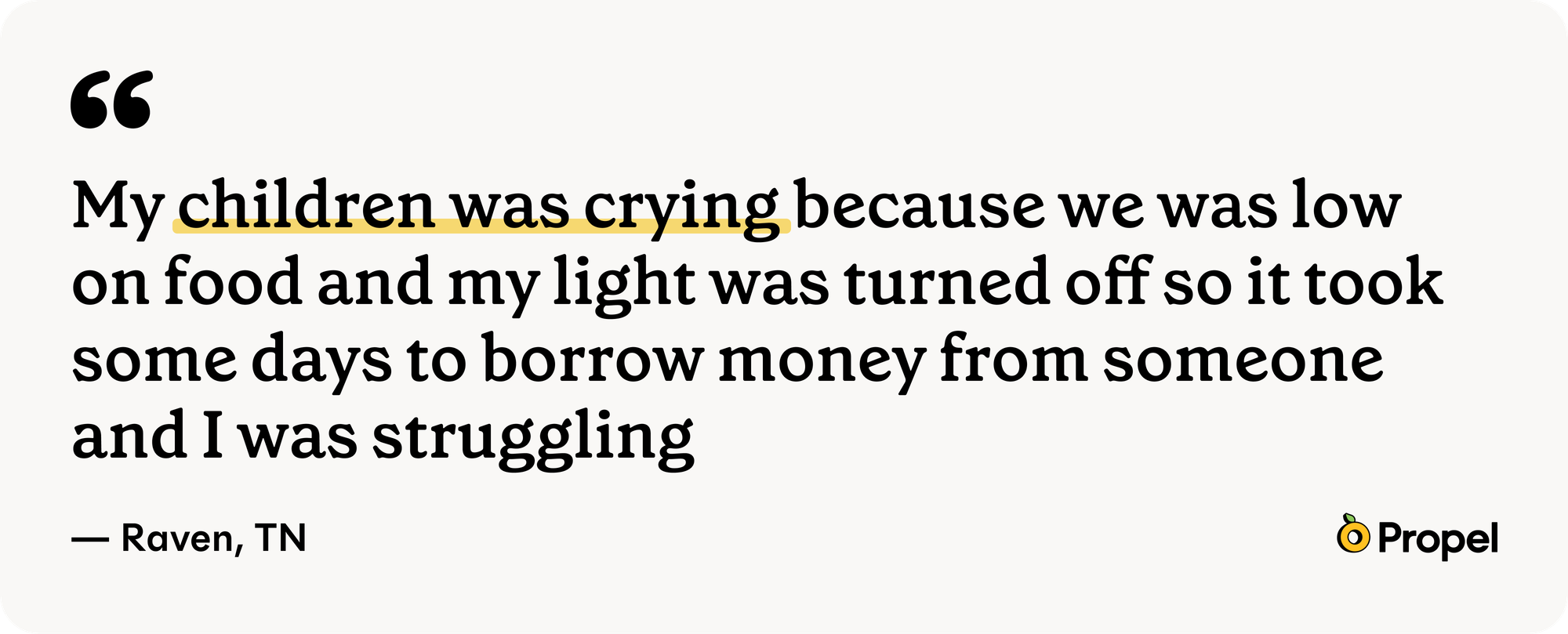
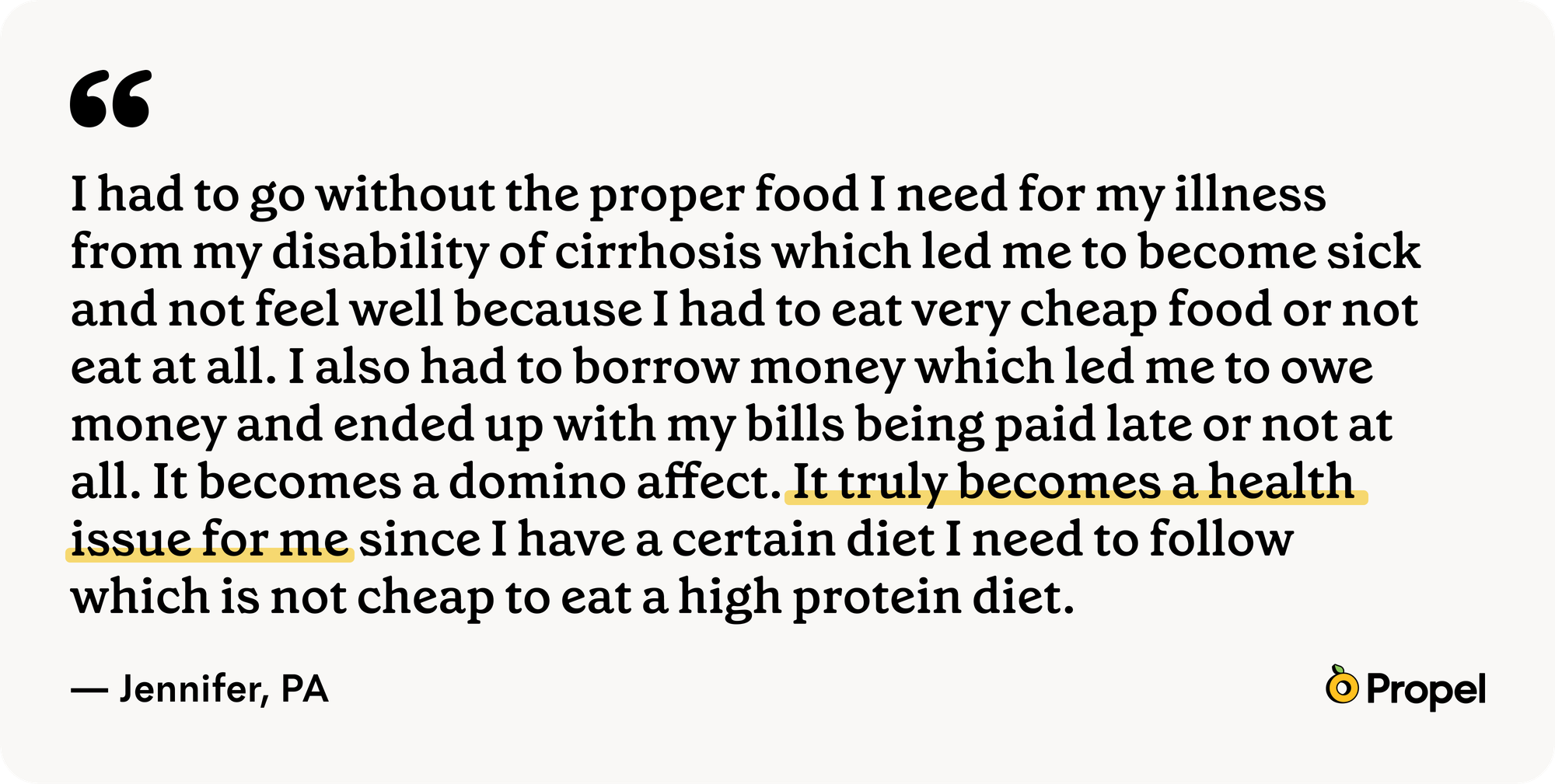
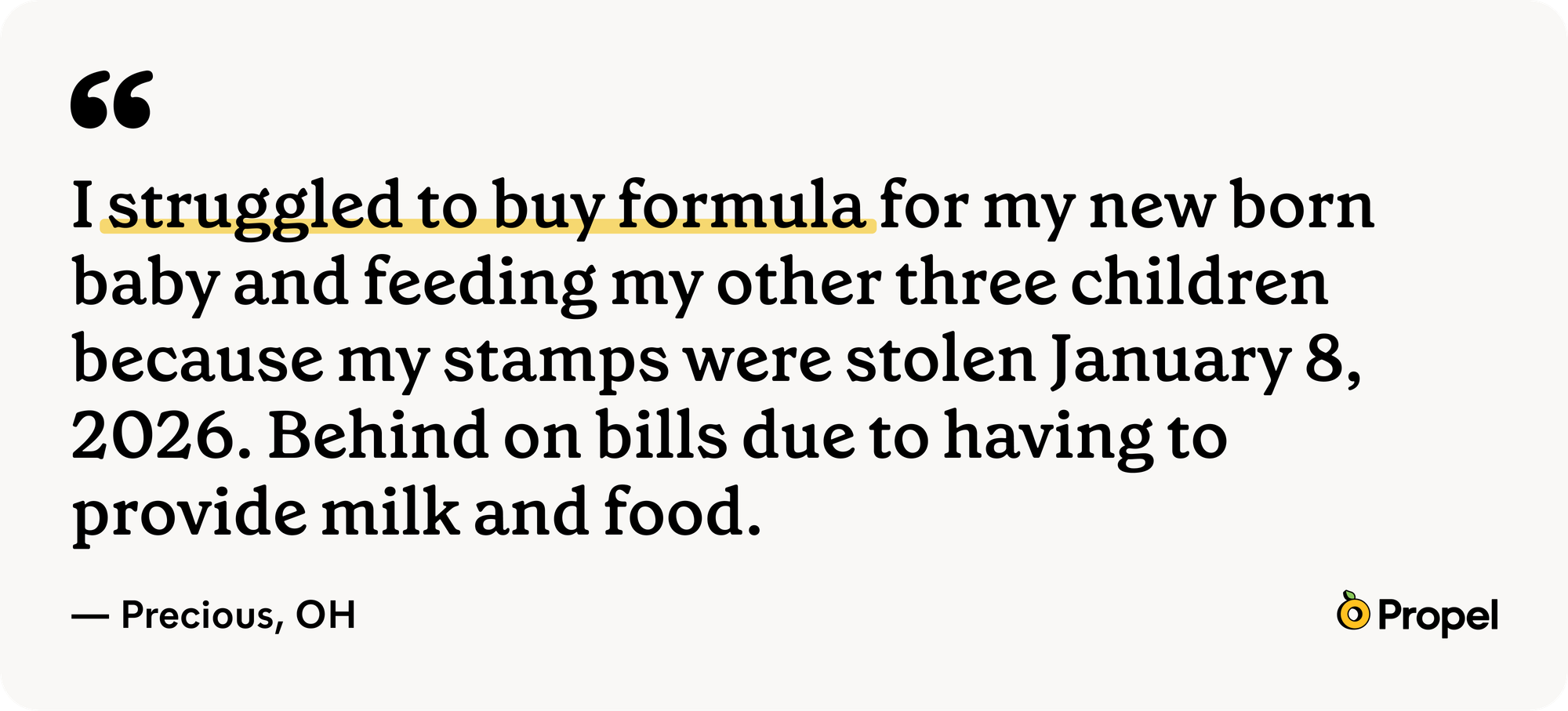
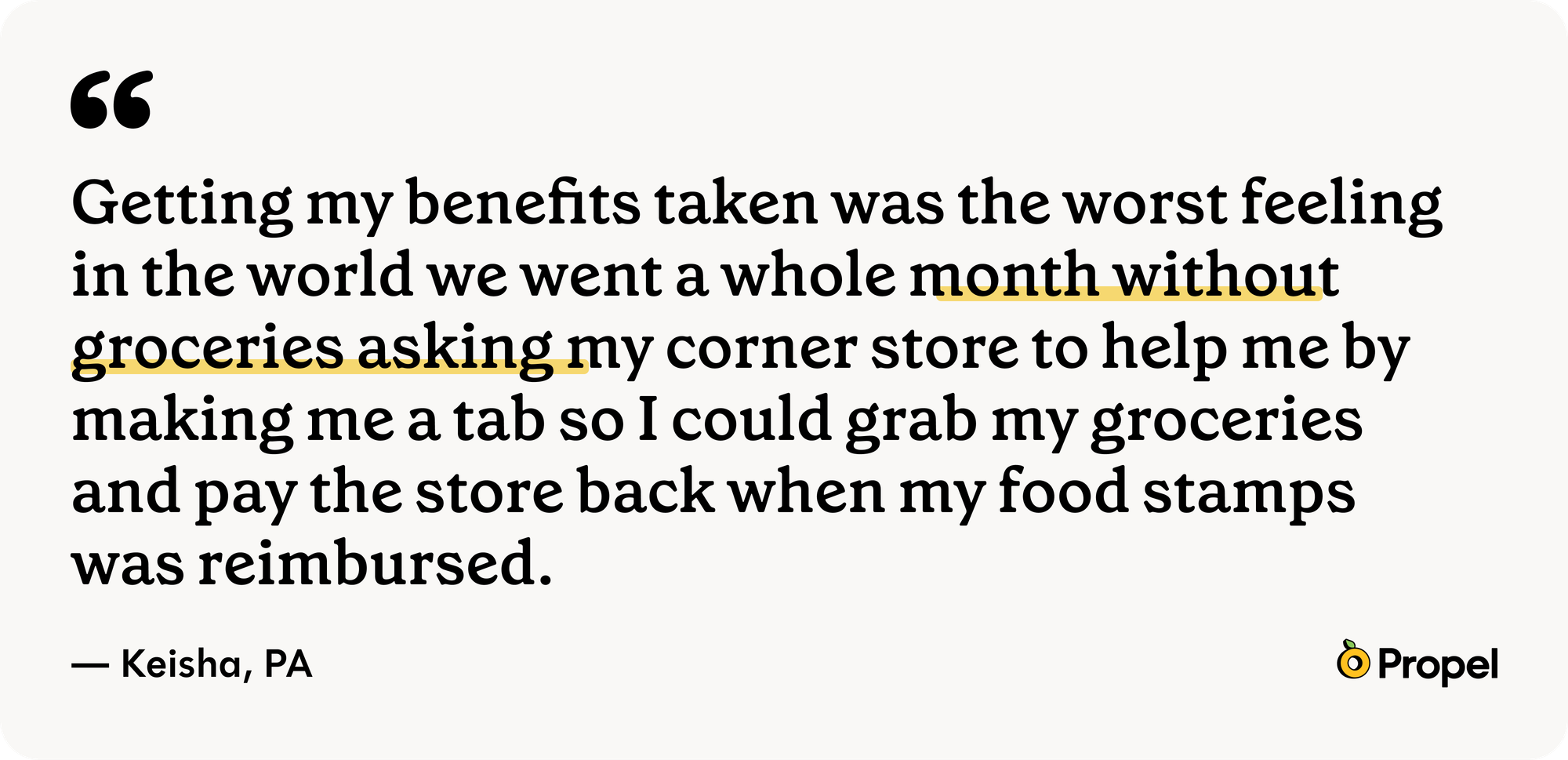
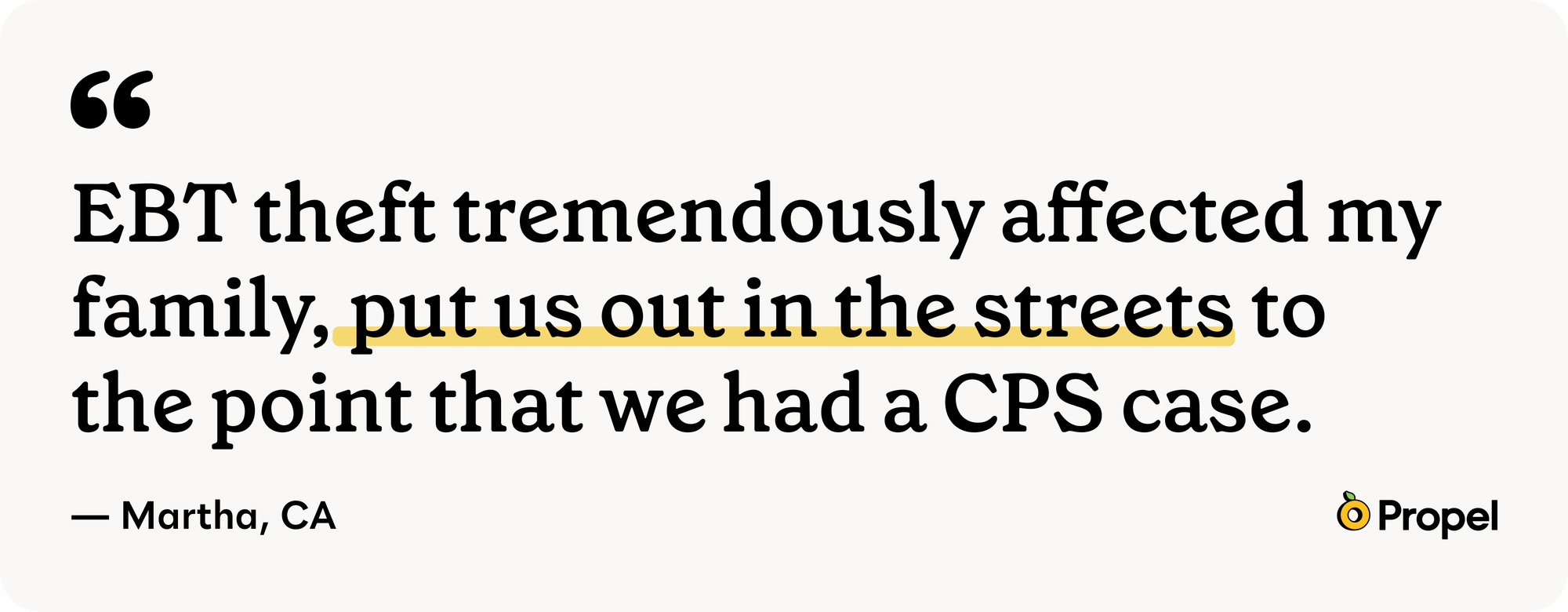
The financial impact of EBT theft extends well beyond the dollar amount stolen. Most victims face intermingled and cascading consequences—increased debt, food insecurity, and reliance on emergency food assistance and late bills and rent are among the added challenges for victimized households.
Security feature adoption#security-feature-adoption
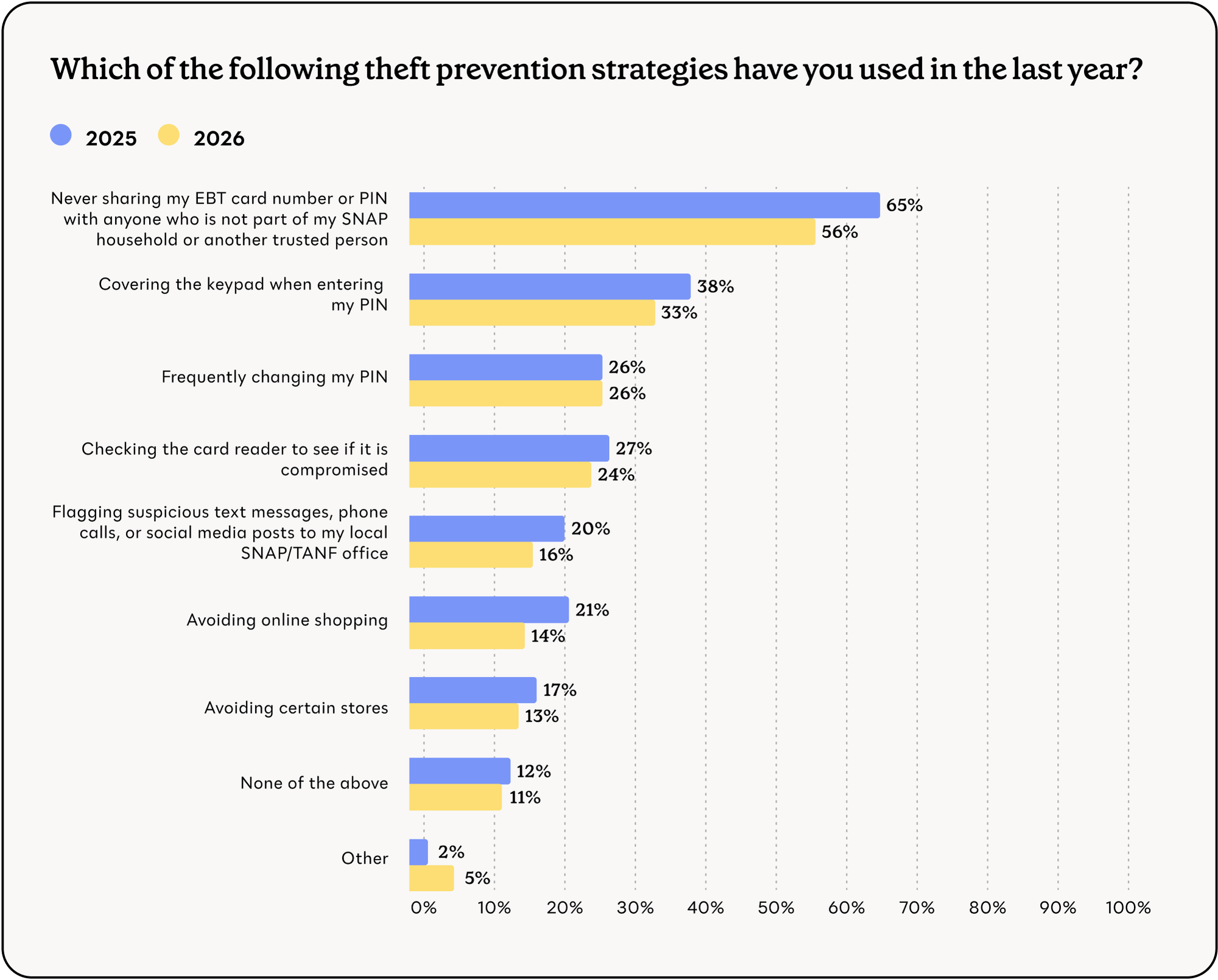
Propel's survey data consistently shows households trying to protect themselves, often with strategies that have limited impact.
Use of digital security tools surged among respondents in 2025. However, these results should be read carefully as reflecting the reality of Propel users more than that of non-Propel user SNAP recipients (see Promoting Security Feature Adoption for more detail). More than half of cardholders who haven't locked their card say they didn't know they could, highlighting a lingering awareness and adoption gap that EBT stakeholders should continue to work to address.
Advancing systemic protections#advancing-systemic-protections
Many consumers are willing to shoulder individual responsibilities to protect their cards, but survey respondents show a clear and growing desire for systemic protections, including chip cards, virtual cards or mobile pay, real-time monitoring and blocking of suspected fraudulent transactions.
Chip cards in California reduce theft, implementation processes are key to success#chip-cards-in-california-reduce-theft-implementation-processes-are-key-to-success
In 2025, California became the first state to issue chip cards for EBT. Chip cards are an important systemic protection for EBT households. The lessons learned in CA will have a profound influence on the experience of millions using EBT across the nation. To learn more, we surveyed 811 households in California about their experience with EBT chip cards.
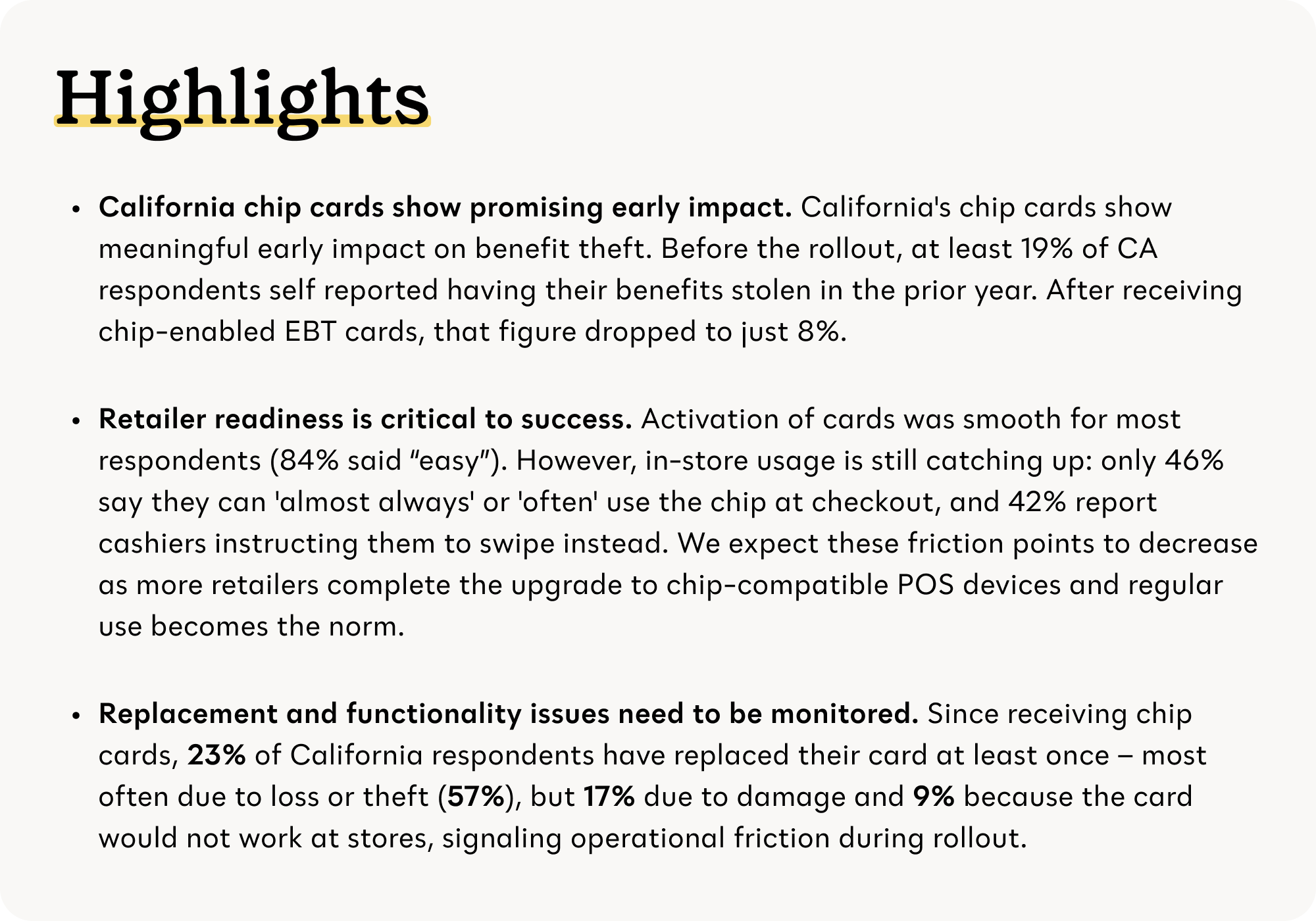
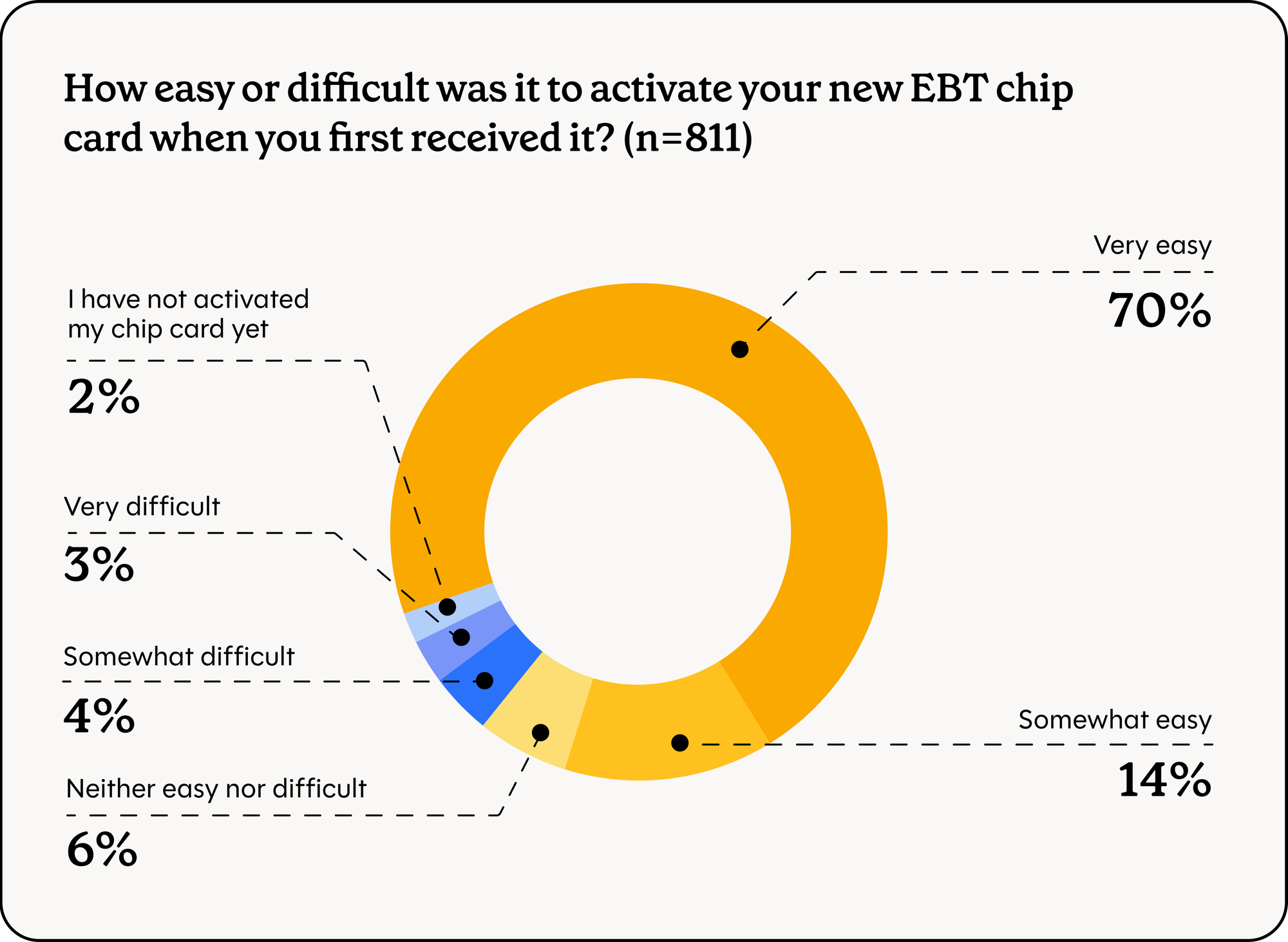
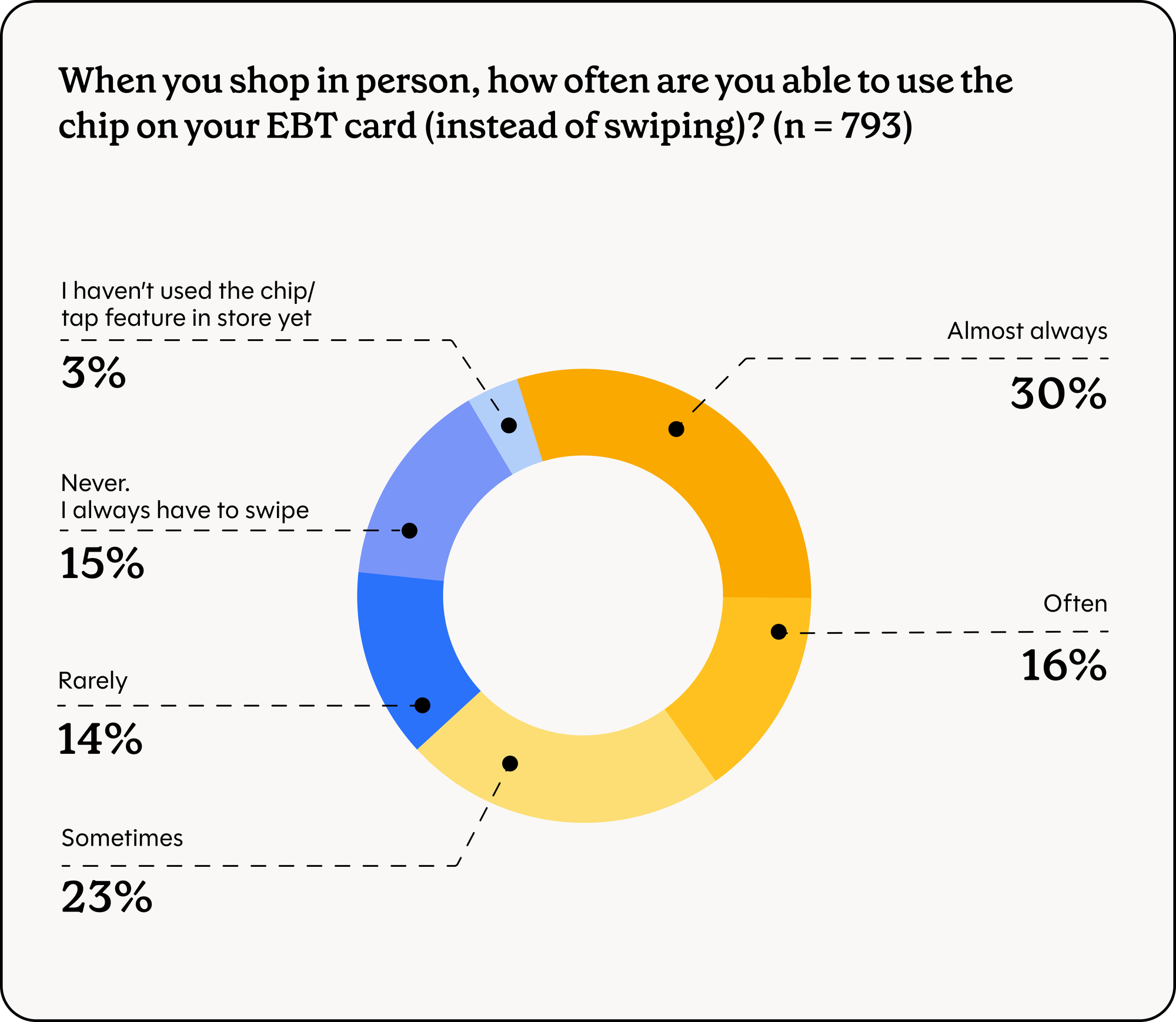
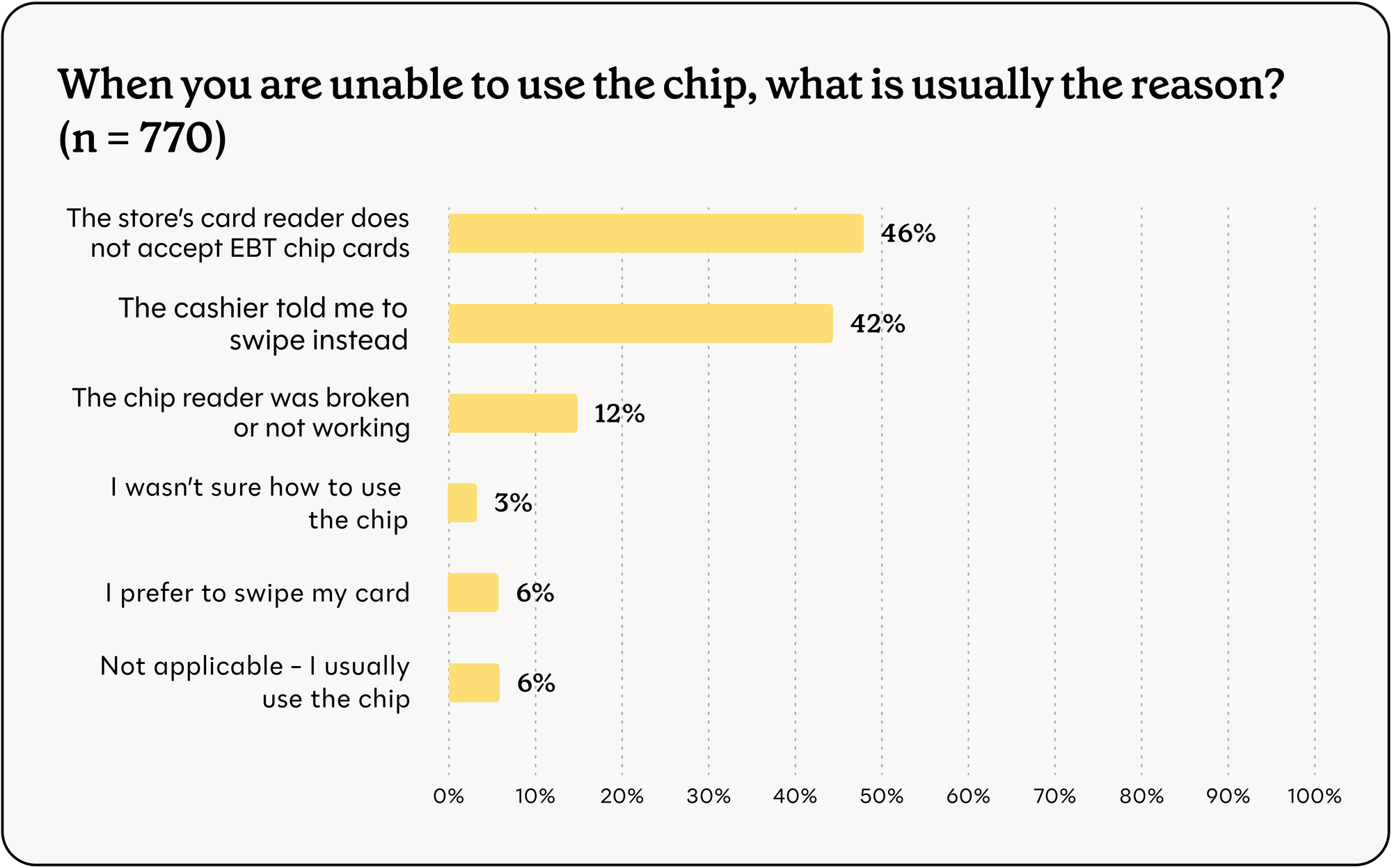
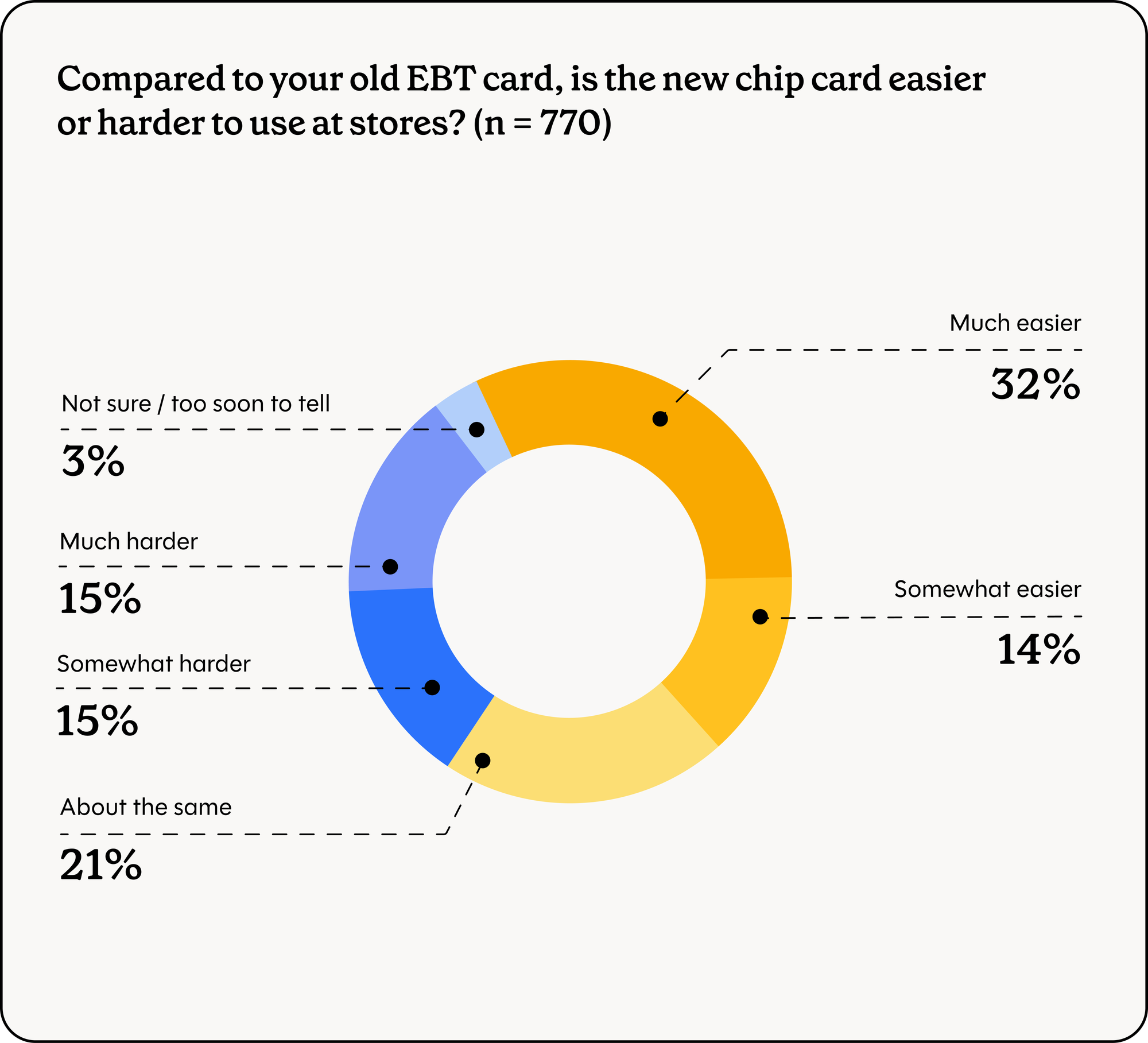
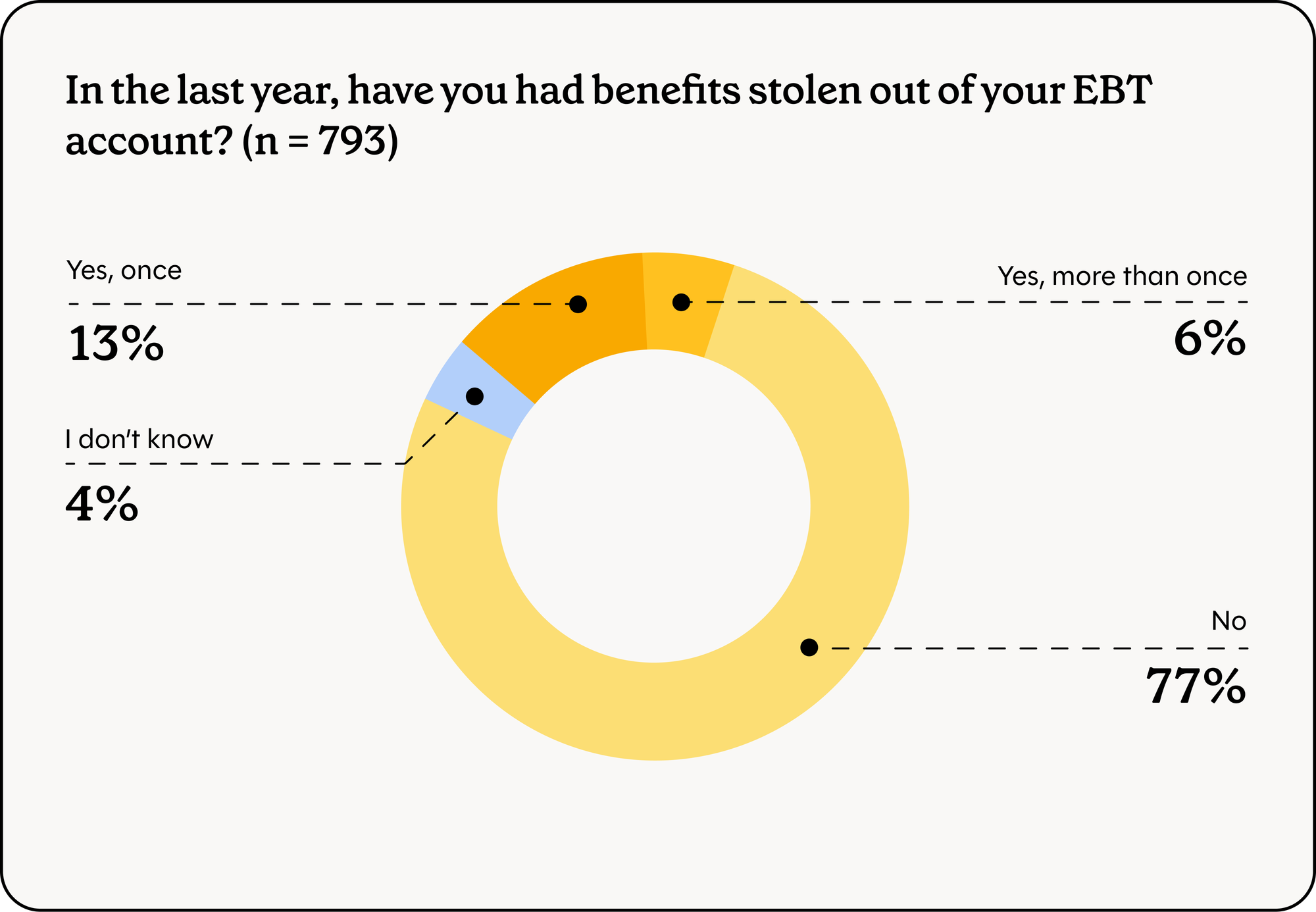
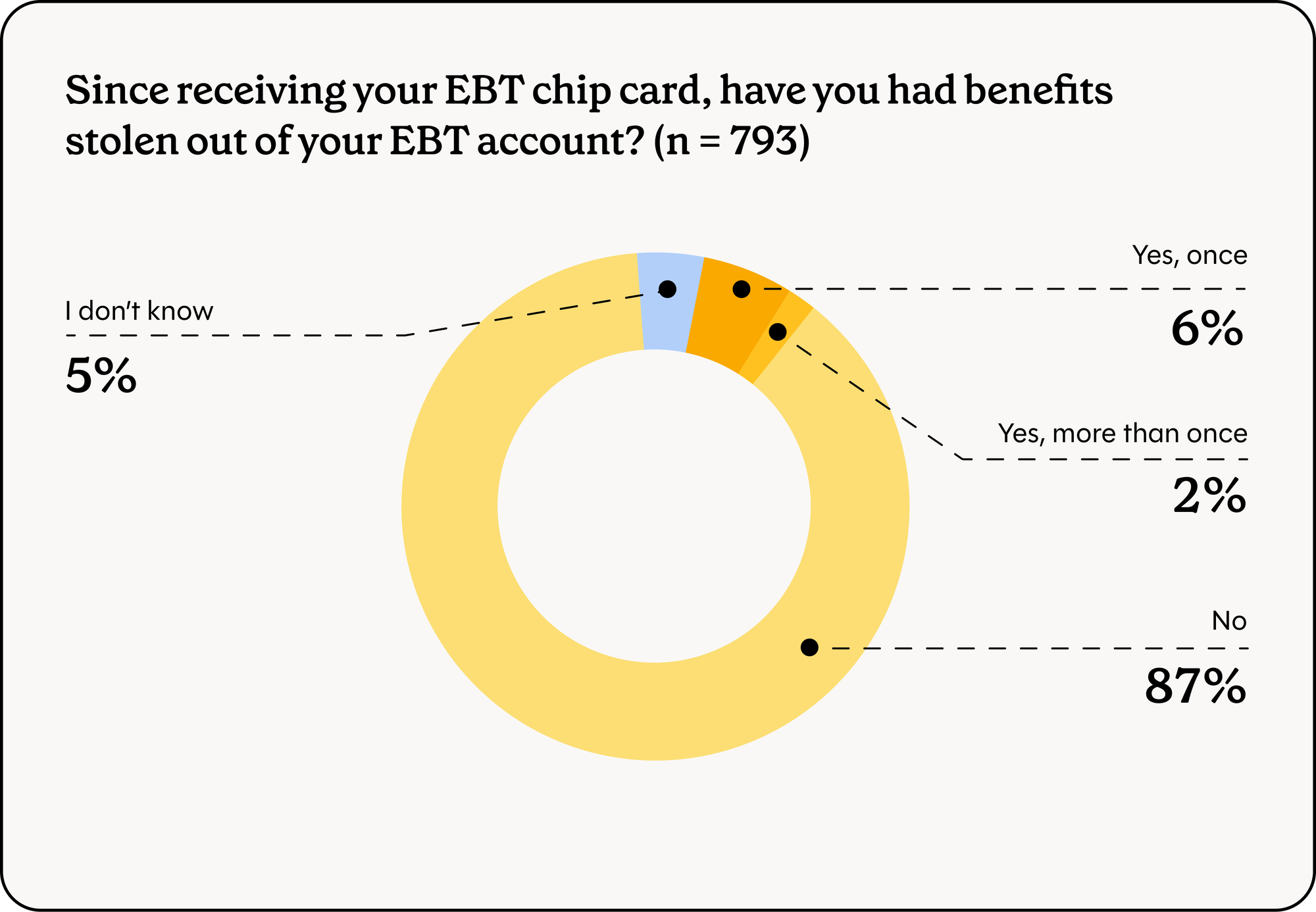
The introduction of EBT chip cards appears to have had a positive impact on the incidence of EBT theft in California. 19% of CA respondents reported being victims of EBT theft in the year prior to taking the survey. By contrast, just 8% report being victims of EBT theft since receiving their EBT chip cards. While not a perfect experiment, this is a promising sign that EBT chip cards will reduce the overall incidence of theft, even with lingering challenges in retailer adoption and other facets of the rollout.
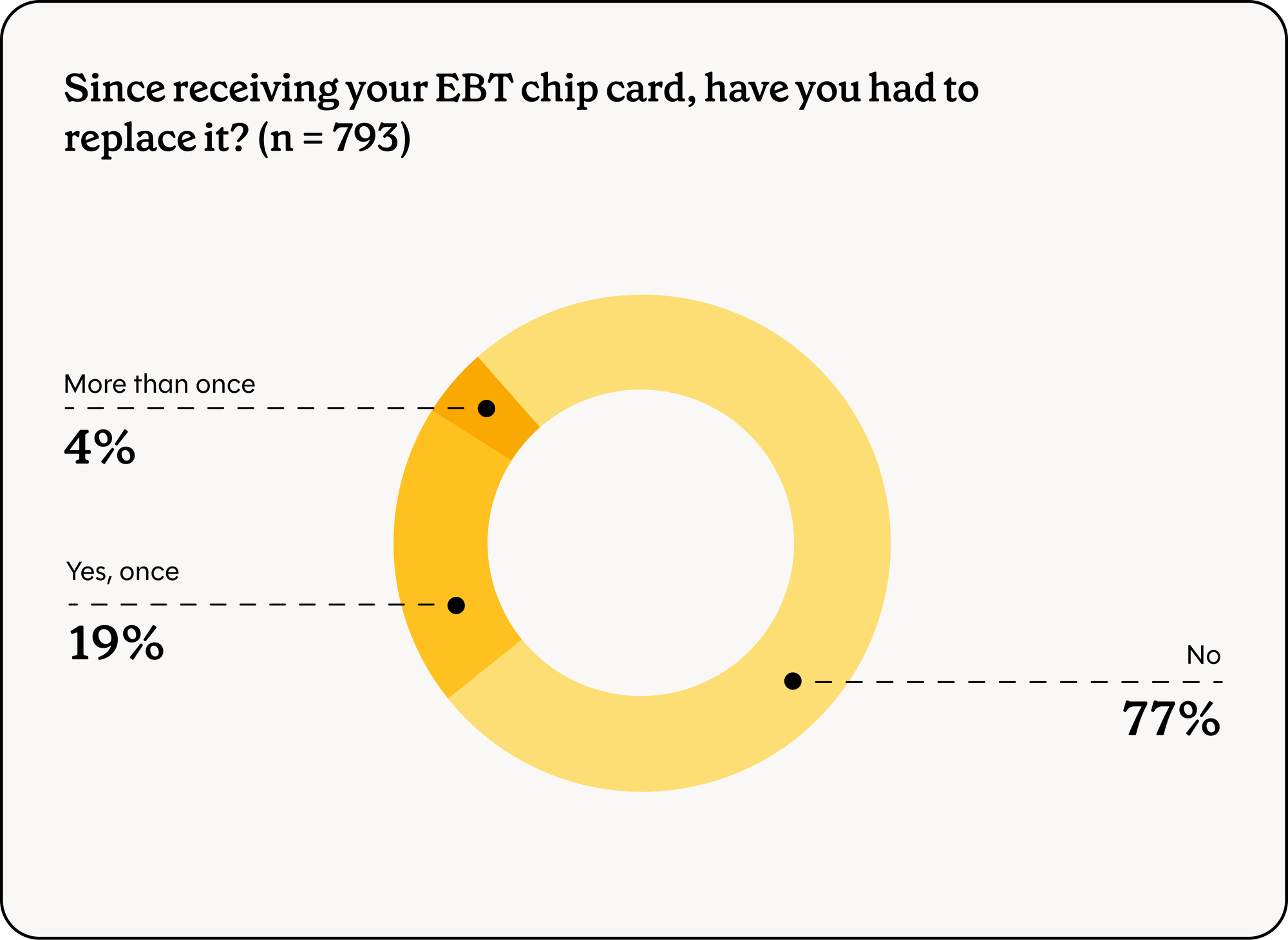
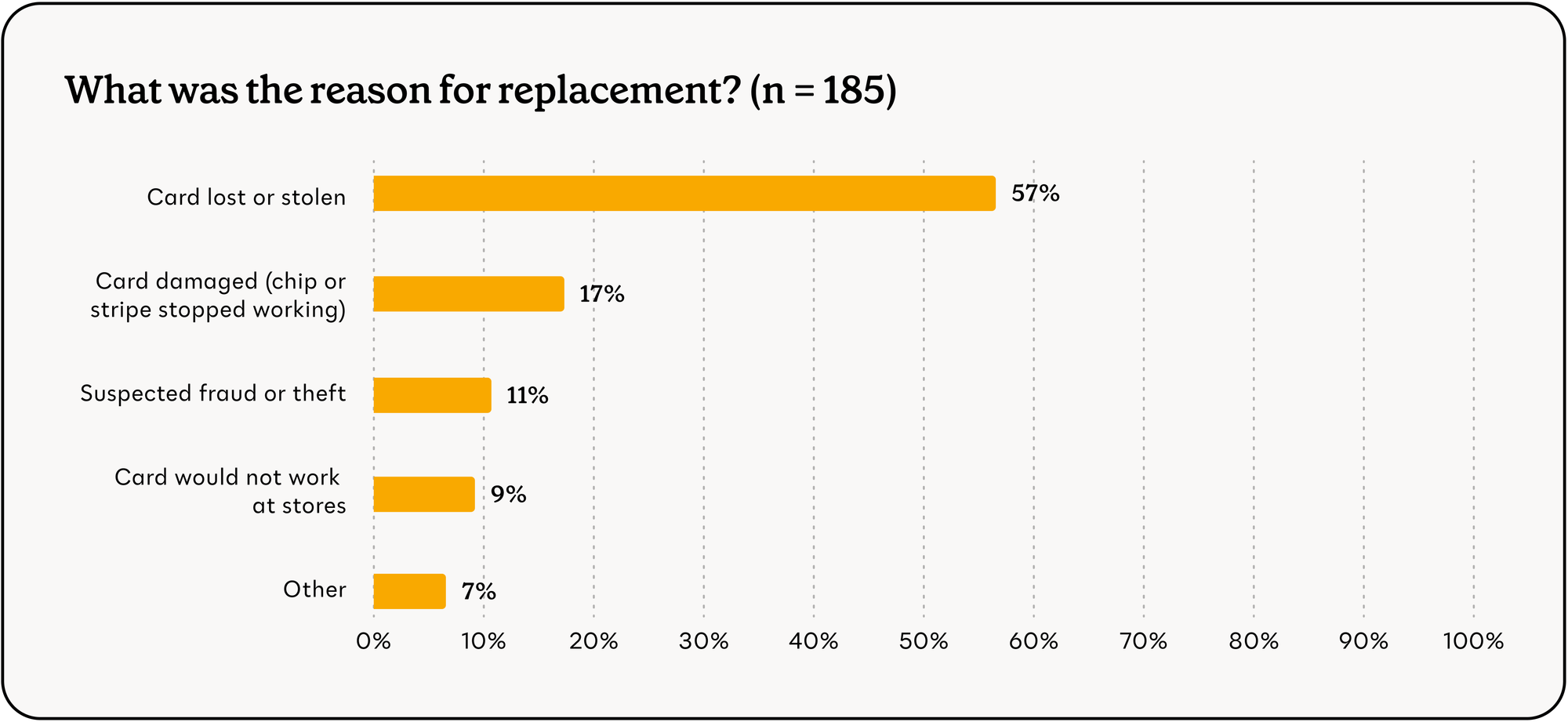
Survey respondents report some issues with their EBT chip cards, with 23% reporting the need to replace their EBT chip card at least once since receiving it. Card loss or theft was the most commonly cited reason for requesting a replacement, but card damage or failure to function were also cited.
Promoting security feature adoption via Propel#promoting-security-feature-adoption-via-propel
To combat rising EBT theft, states and their vendor partners have introduced a variety of new, optional security features in recent years. These security features most commonly involve: card locking, blocking out of state transactions, and blocking online transactions. These features carry varying names across states and vendor platforms, and are commonly, but not universally available.
According to a report by the United States Government Accountability Office (GAO), these security features "are not widely used." The report cited the opt-in nature of the tools, perceived difficulty in usage, and low adoption of EBT processor mobile applications ("5 to 10 percent of EBT recipients used these apps") as barriers to preventing more theft via available security features.
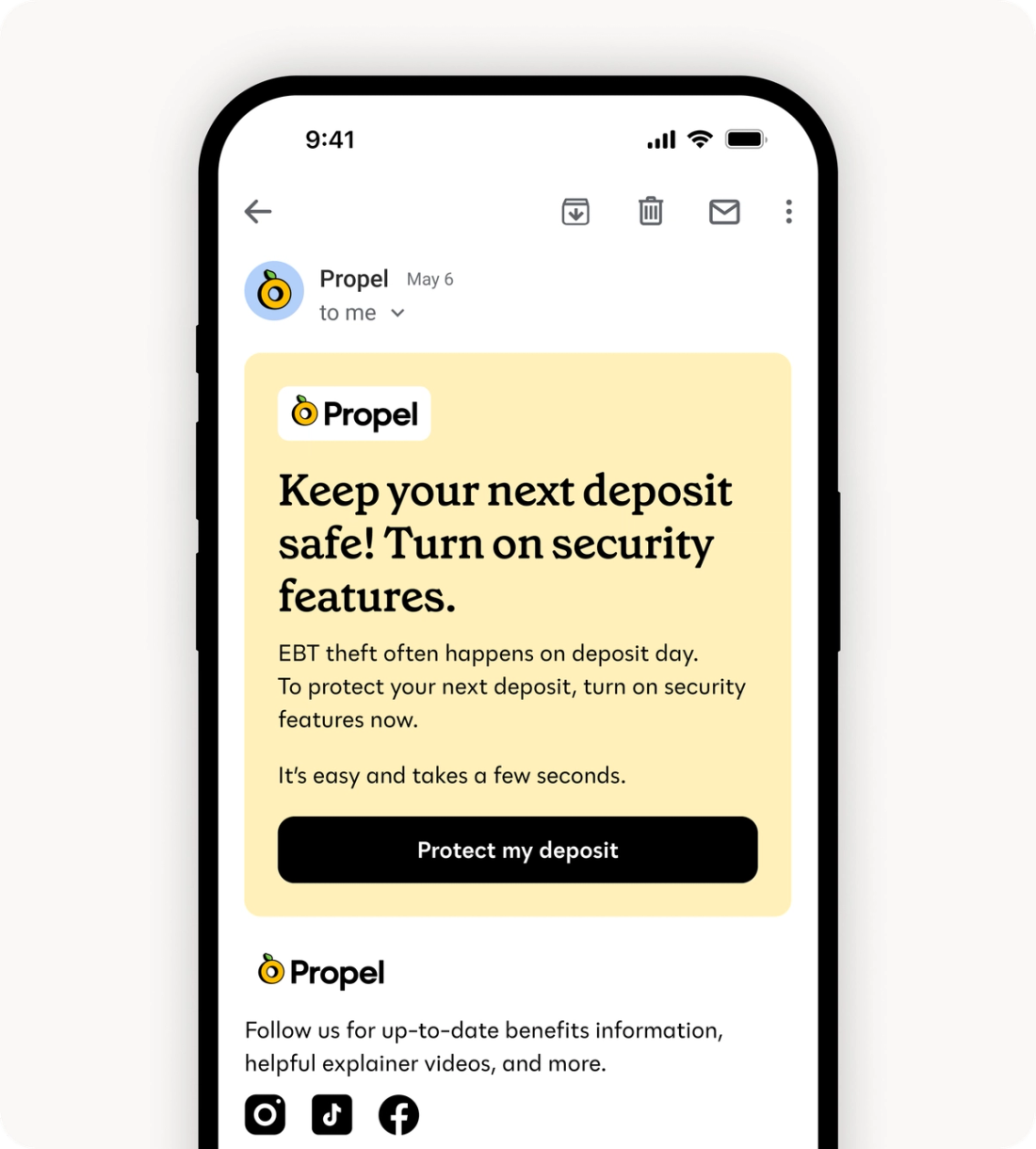
In order to reduce the incidence of EBT theft, Propel launched a dedicated effort in 2025 to promote the adoption of the security features developed by states and their vendor partners. In January 2025, the usage of any security feature among people who use Propel sat at a baseline of 16%. Propel initiated, tested, and iterated a number of product and messaging interventions, aimed at boosting the security feature adoption and blocking EBT theft. Interventions included:
- Deposit-timed reminders to enable security features
- "One-tap" out of state transaction blocking
- Increasing visibility and accessibility of security controls
- Targeted messaging to in-state-only shoppers
As a result of these efforts, 56% of people who use Propel had at least one security feature enabled in December 2025. The Propel app is likely the largest vector for security feature adoption in the EBT landscape. Opt-in security features can be valuable, but achieving widespread adoption is a challenge. Effort, intent, and iteration are valuable tools in helping design effective interventions to promote security feature adoption.
Conclusion#conclusion
EBT theft is a terrible crime, often committed by organized gangs of transnational criminals. The victims of EBT theft include the taxpayer, the caseworker, the agency administrator, and the intended recipient. Households that receive public benefits delivered via EBT are by definition vulnerable, and prone to suffering excess harm from the theft of their benefits. By surveying these households, understanding, and sharing their experiences, Propel hopes that more action can be taken by policymakers to close the security gaps between the EBT system and mainstream financial services.
Mainstream financial services like credit and debit cards use multiple layers of systemic protections in combination with opt-in consumer features to secure the cards, accounts and funds. A similar approach is emerging in EBT, but the progress is slow, and the cost of that pace is measured in missed meals, added debt, and lives knocked off course. Propel continues to fight EBT theft and work to prevent it, and looks forward to working with all who hope to reduce the harm caused by these awful crimes.
Methodology#methodology
Propel conducted this survey between February 1–10, 2026. A total of 8,164 EBT cardholders responded. Unless otherwise noted, all percentages reflect the full respondent pool.
Questions about theft experiences—including loss amounts, transaction types, geographic location, and household impact—were directed to the 1,451 respondents who reported being victimized at least once in the past year.
Responses have not been weighted. Year-over-year comparisons reference Propel's 2025 EBT Theft Survey. Some questions were restructured between survey years.
About Propel#about-propel
Propel is a company that builds technology that strengthens the safety net in America. For more than 10 years, we've been building best-in-class technology for people who receive government benefits. Through the Propel app, a free mobile app for people who receive SNAP and other benefits via EBT, we provide balance checking, transaction history, job search support, and money saving offers to more than five million Americans each month. The Propel app has earned more than 1-million 5-star reviews. Through Propel for States we partner with state health and human services agencies and support state efforts to respond to H.R. 1's new requirements, reduced administrative support, and cost sharing penalties. We help states reduce errors and increase compliance without new systems or staff.
To learn more, visit propel.app, or email press@joinpropel.com.
¹ While we strive for rigor, it should be noted that all respondents are users of the Propel app. Their responses to certain questions are impacted by their experience receiving information, messages, and interventions from Propel. We work to note instances in which their responses may deviate from the SNAP population at-large.
² This methodological approach has limitations. Some legitimate transactions at retailers engaged in frequent fraud may be included. Fraud that is not noticed or reported by users will be undercounted. States with and without detailed retailer data are treated as experiencing theft at similar rates, which may not be accurate. We acknowledge these and other limitations, but we are confident that EBT theft is a vast problem, doing substantial damage to the well-being of already vulnerable American households.