


Helping people plan meals during a pause in SNAP payments
Our editorial promise
All of our Propel editorial content meets our high bar for accuracy, timeliness, trust, and relevance. Our pages are edited and fact-checked to make sure we meet our mission of giving you information you can rely on.
Learn more about our editorial standards.
The government shutdown from October 1 to November 12, 2025 was the longest in United States history and millions of Americans experienced unprecedented delays in their SNAP payments.
During this time, Propel introduced an AI-powered meal-planning assistant to help people create simple, affordable meals using ingredients and equipment they already had access to – whether that meant a full kitchen or just a microwave and a few canned goods.
It's a problem well-suited for LLMs: recipes are natural language, everyone's pantry and kitchen setup is different, and there's no single right answer – just options that work for each person's situation.
We built on top of frontier models from OpenAI and Anthropic and launched the assistant within the Propel app as a free feature. We added a detailed system prompt to shape the experience – making sure the bot asked about ingredients and equipment first, worked within real constraints, and never assumed a full kitchen or stocked pantry. The responses were guided by a few core principles:
Meet people where they are.
Always start by asking what people already have on hand. Don’t assume access to ovens, spice racks, or specialty ingredients. Recipes should work with single hot plates, microwaves, or whatever’s available.
Consider people’s budget without being condescending.
Provide suggestions on ways to stretch ingredients and find affordable solutions, but never use labels like “low-income” or take a patronizing tone.
Use a warm and friendly tone, but don’t be performative.
Encourage people genuinely. Celebrate small wins with empathy, but don't be overly enthusiastic or minimize difficult circumstances.
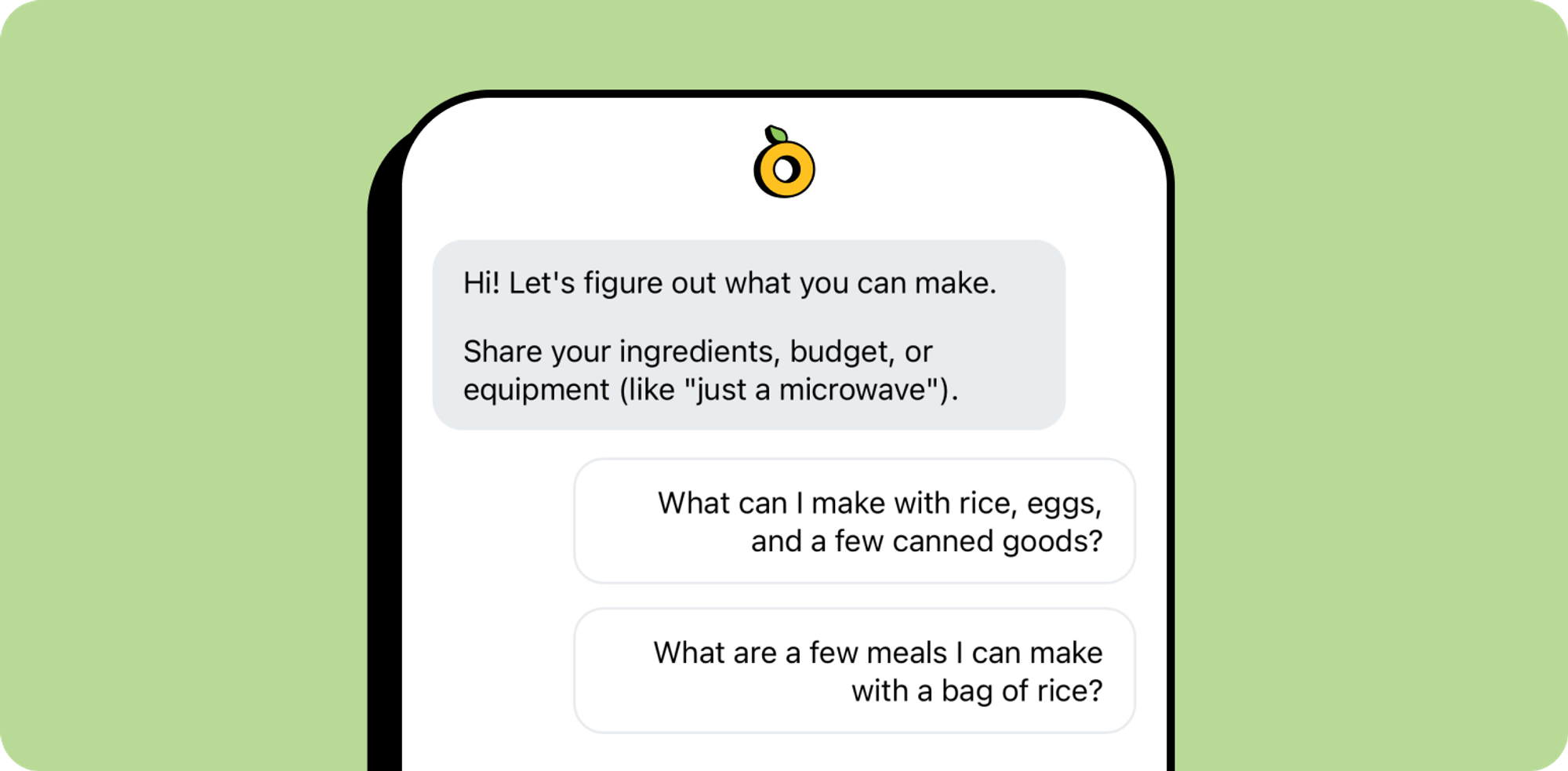
How people interacted with the assistant#how-people-interacted-with-the-assistant
On October 28, 2025, we launched the recipe assistant to a small percentage of people using the Propel app. Over the course of the government shutdown, there were over 600 chats were initiated by people to get advice on what recipes they could make.
Of those threads, 30% of them had multiple messages between the user and the assistant. Roughly 9% of people came back to the assistant to start a chat more than once.
Amongst the people who were most engaged with the assistant, there were a couple of threads that stuck out to us. The specific details of these conversations have been altered to protect privacy.
One person came back to chat with the assistant five times over the course of three days. They were very health-conscious, asking about how to make meals for someone with a specific health condition. They provided a list of ingredients that they had on hand, such as chicken, rice, and potatoes, and asked how they might be able to stretch these across multiple meals.
Another person listed their appliances and ingredients, starting with a question about how to make something quick and cheap for lunch. They continued to work through different ideas with the assistant, asking for additional suggestions after being presented with an initial idea. They continued to add more details about their preferences until they got to a set of meal ideas that they liked.
Using AI to analyze the impact of the feature#using-ai-to-analyze-the-impact-of-the-feature
To understand how people were using the assistant, we used an LLM analyze the messages sent to and from the bot. We loaded chat logs into a document index and connected it to the bot with retrieval-augmented generation to parse the messages. Product managers and data scientists could then ask additional questions about the logs and get quick insights into conversation patterns and trends.
To develop some more quantitative insights, we also used Claude Code to analyze the usage records. Given a prompt, Claude wrote SQL queries to understand patterns in the data and provide answers to our more specific data questions.
Shipping features quickly during a crisis#shipping-features-quickly-during-a-crisis
Over 5 million people use the Propel app each month to manage their EBT benefits. They often look to us as a trusted partner to navigate government benefits. In times of crisis, we can quickly deploy new features to people via a channel that they are familiar with.
Using AI-assisted coding, we built this feature in a matter of days rather than months. A small team across product, marketing, and design came together to build and ship this tool to play a small part in helping people figure out how to continue to feed their families during an unprecedented pause in SNAP benefits.