Food stamp recertification: Everything you need to know
Our editorial promise
All of our Propel editorial content meets our high bar for accuracy, timeliness, trust, and relevance. Our pages are edited and fact-checked to make sure we meet our mission of giving you information you can rely on.
Learn more about our editorial standards.



Additional expert review by
- What is food stamp recertification?
- When do I need to apply for food stamp recertification?
- How do I submit a food stamp recertification?
- What documents do you need for SNAP recertification?
- SNAP recertification interview: what they'll ask
- Why your SNAP benefit amount could change at renewal
- What if I miss the food stamp recertification deadline?
- FAQs
Table of contents
- What is food stamp recertification?
- When do I need to apply for food stamp recertification?
- How do I submit a food stamp recertification?
- What documents do you need for SNAP recertification?
- SNAP recertification interview: what they'll ask
- Why your SNAP benefit amount could change at renewal
- What if I miss the food stamp recertification deadline?
- FAQs
Everyone who gets SNAP (also called food stamps) needs to recertify periodically to keep receiving deposits. If you don’t complete recertification before your current benefits expire, you may stop getting SNAP deposits altogether and need to start the application process over from scratch.
Depending on your specific situation, you may need to recertify your benefits every six to 12 months or every couple of years.
It's usually a simpler process than your original application, and your state should send you a recertification packet with instructions when it's time to recertify.
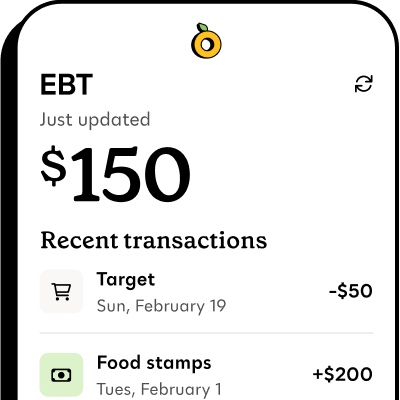
Propel is the #1-rated EBT balance checking app
What is food stamp recertification?#what-is-food-stamp-recertification
Food stamp recertification is just the process required to keep getting your SNAP benefits. It’s basically a check-in to make sure you still qualify for benefits and that your needs haven’t changed (some people may need more than what they’re currently receiving).
The food stamp recertification process is required by federal law—it helps make sure that people are getting the right amount of benefits.
Recertification is faster and easier than initially applying for food stamps: Your state agency will send instructions, but generally you need to complete a recertification form, attend a recertification interview, and provide any required documents.
When do I need to apply for food stamp recertification?#when-do-i-need-to-apply-for-food-stamp-recertification
You need to apply for food stamp recertification before your “active” or “certifications” period is up—that’s just the amount of time you were initially approved for benefits.
Your certification period was set in your initial SNAP approval letter. For most households, it's between six and 12 months, but it can be as long as 24 months (or longer in some states for elderly or disabled households).
If you no longer have your food stamp approval letter, visit your state’s online portal or reach out to your local benefits office.
But you’ll also know when it’s time to recertify because you’ll likely receive a recertification package with a notification that your benefits are ending, along with information about how to complete recertification.
What is a food stamp recertification package?#what-is-a-food-stamp-recertification-package
State agencies are required to send you a Notice of Expiration at least a month before your benefits expire. Depending on your state, the notice may come even earlier, up to six months before your benefits expire.
Along with a Notice of Expiration, you’ll also receive a recertification package in the mail.
The food stamp recertification package may include:
- The expiration date of your current benefits and the deadline to submit your recertification
- A recertification form (to fill out online or mail in)
- A recertification interview appointment letter or instructions to schedule one
- A list of the documents you’ll need to recertify
How do I submit a food stamp recertification?#how-do-i-submit-a-food-stamp-recertification
While specific guidelines vary by state, here’s what you’ll probably have to do to recertify your SNAP benefits:
1. Complete the recertification form
The food stamp recertification form or application was likely included in your recertification package. While the application will vary by state, it will involve sharing household information. Some states allow you to fill this form out online, while others will require applicants to mail it in or bring it to their benefits office.
Read the application carefully to avoid making simple mistakes that could hold up the recertification process.
2. Attend a recertification interview
The purpose of the recertification interview is to verify that the information you shared in the recertification application is accurate.
States must schedule SNAP recertification interviews early enough to allow households at least 10 days after the interview to submit any required verification before their certification period ends.
Some states might not schedule your recertification interview until after you’ve sent in your recertification application, while others will automatically schedule it when sending out the recertification package. And some states consider the interview to be a recertification application and don’t require a separate online or paper application for approval.
If you didn’t get an interview date in your recertification package, you may need to call your SNAP office to schedule one. Remember, failure to attend or schedule a recertification interview can delay or jeopardize the renewal of benefits.
3. Share any additional information post-interview
Depending on how the interview goes, your local SNAP office might ask for additional information before recertifying—like proof of income changes or living expenses. Provide this follow-up documentation as soon as possible to avoid any delays in recertification.
4. Approval or denial
If your recertification is approved, your EBT card will be reloaded next month, and you’ll keep getting benefits as usual (in some situations, you may receive a new EBT card in the mail). If you are not approved for food stamp recertification, you can appeal the decision.
What documents do you need for SNAP recertification?#what-documents-do-you-need-for-snap-recertification
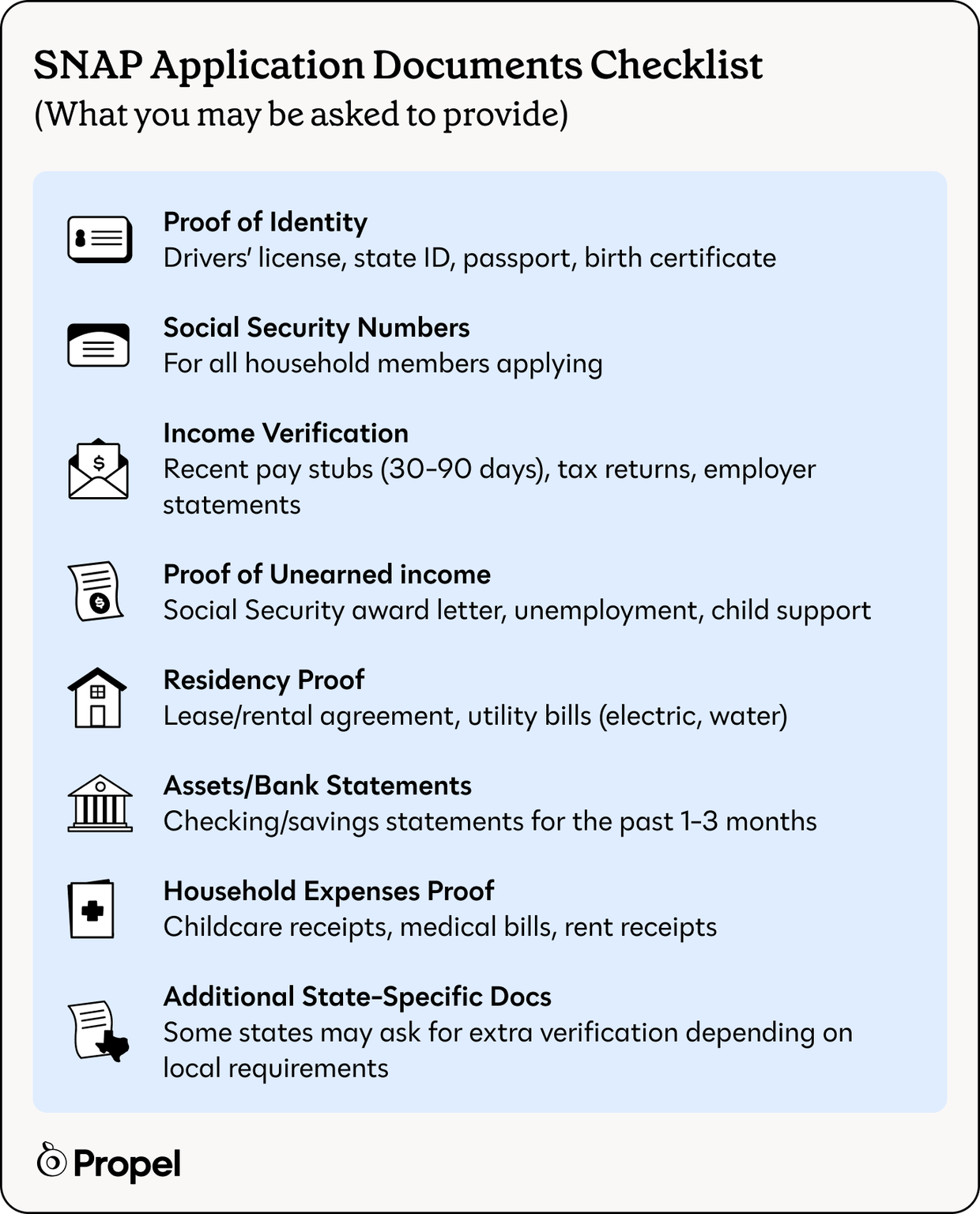
Your state's recertification packet will include a specific document list, but here's what's typically required across most states.
- Government-approved ID, including a license, passport, or Social Security card
- Information about all your household members
- Proof of income or wages
- Proof of any additional income, including Social Security benefits, pension, or disability payments
- Proof of residency
- Immigration status documentation
You may not need all of these—your state will typically only ask you to verify what has changed since your last certification.
SNAP recertification interview: what they'll ask#snap-recertification-interview-what-theyll-ask
The recertification interview is usually 10 to 30 minutes by phone. Its purpose is to verify that the information in your recertification form is accurate and that your household's circumstances haven't changed significantly.
Common questions may include:
- Has anyone moved into or out of your household?
- Has your income changed since your last recertification?
- Are you still at the same address?
- Do you have any new sources of income, like a new job or benefits?
- Are there changes to your rent, mortgage, or utility costs?
- Does anyone in your household have significant medical expenses? (especially for elderly/disabled members)
Tips for your interview:
- Have your documents in front of you when you call (or when the caseworker calls you).
- Answer questions honestly and completely—inconsistencies between your form and your interview can delay approval.
- If you don't understand a question, ask the caseworker to clarify before answering.
- If you need a language interpreter, your state SNAP office is required to provide one—request this when scheduling.
What if you miss your interview?#what-if-you-miss-your-interview
If you miss a scheduled recertification interview, contact your SNAP office as soon as possible. Most states allow you to reschedule, but within a limited window. Missing the interview without rescheduling can cause your benefits to lapse.
Why your SNAP benefit amount could change at renewal#why-your-snap-benefit-amount-could-change-at-renewal
When you renew your SNAP benefits, your state reviews your household information, including your income, household size, and expenses. Your benefit amount may change if any of these details are different from when you first applied or last renewed.
Your benefit may decrease if:
- Your household income increased
- A household member moved out
- Expenses like mortgage, rent, or utility costs went down, or deductions you previously claimed no longer apply
Your benefit may increase if:
- Your income went down
- Your household grew
- Your allowable expenses (rent, utilities, medical costs) increased
What if the change seems wrong?#what-if-the-change-seems-wrong
If your new benefit amount doesn't seem to match your actual circumstances, you have options:
- Contact your SNAP office and ask them to explain how your benefit was calculated. You have the right to see the calculation.
- Request a fair hearing if you believe the amount is incorrect. You generally have 90 days from receiving your notice to request one.
- Resubmit documentation if the office did not receive updated information about your expenses or income.
Benefit changes usually take effect at your next deposit after your recertification is processed, so it’s important to review your notice and act quickly if something looks incorrect.
What if I miss the food stamp recertification deadline?#what-if-i-miss-the-food-stamp-recertification-deadline
If you don’t get a chance to apply for food stamp recertification before your benefits expire, most states offer a 30-day window to reapply.
After the 30-day window, you may need to start the food stamp application process over again from the beginning, and your deposits will likely stop while you wait to qualify again.
FAQs#faqs
How do I document zero income for SNAP recertification?#how-do-i-document-zero-income-for-snap-recertification
Having no income doesn't disqualify you from SNAP, but you'll need to verify it. Common ways to document zero income include a signed self-declaration form (ask your caseworker if your state has one), a termination letter from a former employer, documentation showing the end of unemployment benefits, or bank statements showing no incoming deposits.
If you report zero income, your caseworker may ask how you're covering basic expenses. Be ready to explain honestly (for example, that a family member is helping). If you're missing a specific document, let your caseworker know right away; they may be able to accept a written statement instead.
Can I recertify for food stamps online?#can-i-recertify-for-food-stamps-online
Yes, some states allow you to apply for food stamp recertification online. Check any recertification information you received by mail or email, or call your state’s SNAP phone number to find out what the process is.
How long does food stamp recertification take?#how-long-does-food-stamp-recertification-take
Food stamp recertification approval should happen within two weeks of completing the application process, if not sooner. Sending in the recertification application as soon as possible and appearing for the scheduled recertification interview will help move the process along.
How do I follow up on a pending SNAP recertification?#how-do-i-follow-up-on-a-pending-snap-recertification
You should receive a decision within 30 days of submitting your recertification. To check your status, log into your state's SNAP portal, call your local office, or check any mailed notices.
If your benefits are about to run out and you still haven't heard back, call immediately—you may be able to request interim benefits while your case is processed. When you call, have your case number and submission date ready, and ask whether your recertification was received, whether anything is missing, and when to expect a decision.
Can you recover SNAP benefits after a lapse?#can-you-recover-snap-benefits-after-a-lapse
It depends on why your benefits lapsed. If the gap was caused by a state error or processing delay—for example, your SNAP office lost documents you submitted on time—you may be entitled to retroactive benefits. File a fair hearing request as soon as possible and document when you submitted your recertification.
If you missed the deadline yourself, you generally can't recover benefits for the lapsed period, but reapplying within 30 days means most states will process it as a renewal rather than a new application.
What's the difference between a SNAP delay and a denial?#whats-the-difference-between-a-snap-delay-and-a-denial
A delay means your case is still being processed, and benefits may resume once it's complete. A denial means your recertification was formally rejected—you'll receive a written notice, and you typically have 90 days to appeal.
If SNAP claims it never received documents you submitted, first check your records for a confirmation number, fax log, or delivery receipt. Then resubmit immediately with a note stating when you originally sent them. If that doesn't resolve it, ask to speak with a supervisor and consider filing a fair hearing request—you can present your evidence that documents were submitted on time.
Do people over 60 have to recertify for SNAP?#do-people-over-60-have-to-recertify-for-snap
Yes, but it may be simpler. At least 24 states and DC have currently adopted the Elderly Simplified Application Project (ESAP), which offers longer approval periods, less paperwork, and no required interview for seniors and people with disabilities with no earned income.
States with ESAP include Alabama, Arizona, Arkansas, California, Connecticut, District of Columbia, Florida, Georgia, Illinois, Indiana, Kentucky, Louisiana, Maryland, Massachusetts, Mississippi, New Mexico, New York, Ohio, Pennsylvania, Rhode Island, South Carolina, Texas, Vermont, Virginia, and Washington.
If your state isn't on that list, you'll recertify the same way as everyone else.